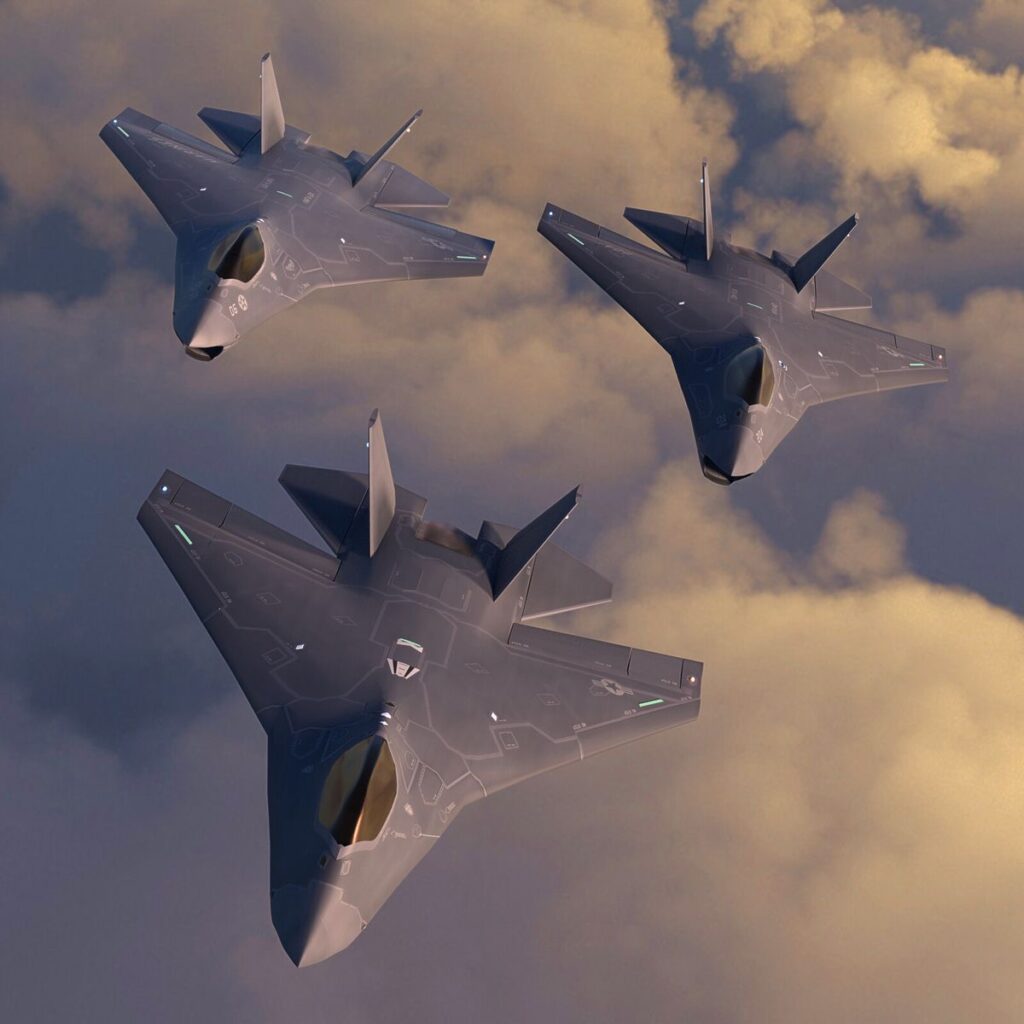
The Boeing F-32 Joint Strike Fighter was Boeing’s entry in the competition that ultimately produced the United States’ next generation multirole stealth aircraft. Known during development as the X-32, the aircraft was designed to meet the requirements of the Joint Strike Fighter program, a major defense initiative launched by the United States in the 1990s to replace a wide range of aging aircraft across the Air Force, Navy, and Marine Corps.
The program sought a family of aircraft that could perform ground attack, air superiority, and reconnaissance missions while incorporating stealth technology and advanced avionics. Boeing competed against Lockheed Martin, whose X-35 prototype would later evolve into the F-35 Lightning II. Although Boeing’s design demonstrated several innovative ideas, it was ultimately not selected for production.
One of the most distinctive aspects of the F-32 was its unconventional appearance. The aircraft featured a large, chin-mounted air intake and a delta wing configuration. This gave it a stocky and somewhat bulbous profile compared to its sleeker rival. Boeing’s design philosophy emphasized simplicity and cost control. The company aimed to reduce manufacturing complexity by using fewer parts and common structures across the different variants.
The Joint Strike Fighter program required three variants: a conventional takeoff and landing version for the Air Force, a carrier-based version for the Navy, and a short takeoff and vertical landing variant for the Marine Corps. Boeing developed two primary demonstrators, the X-32A and X-32B. The X-32A was built for conventional flight testing, while the X-32B incorporated modifications for short takeoff and vertical landing capability.
For vertical lift, Boeing chose a direct lift system that redirected engine thrust downward. This differed from Lockheed Martin’s approach, which used a separate lift fan system driven by the engine. While Boeing’s solution was mechanically simpler, it posed challenges in meeting performance requirements, particularly in hot and high conditions. During testing, the X-32 demonstrated stable flight characteristics, but it struggled to match the agility and overall performance of its competitor.
The cockpit of the F-32 reflected modern fighter design principles. It featured advanced digital displays and was intended to support network-centric warfare. Stealth considerations were also central to the aircraft’s design. The airframe incorporated radar-absorbing materials and shaping techniques intended to reduce its radar cross section. However, some analysts believed that the aircraft’s larger intake and overall geometry may have presented greater radar signature challenges compared to the competing design.
In 2001, the Department of Defense selected Lockheed Martin’s proposal for full-scale development. The decision was based on a combination of performance, risk assessment, and growth potential. While Boeing did not win the contract, the experience gained during the competition contributed to future aerospace projects and deepened the company’s expertise in advanced fighter technologies.
Today, the Boeing F-32 remains a fascinating chapter in military aviation history. It represents both the ambition of the Joint Strike Fighter program and the intense competition that drives innovation in aerospace engineering. Although it never entered service, the F-32 played a meaningful role in shaping the future of modern combat aircraft development.