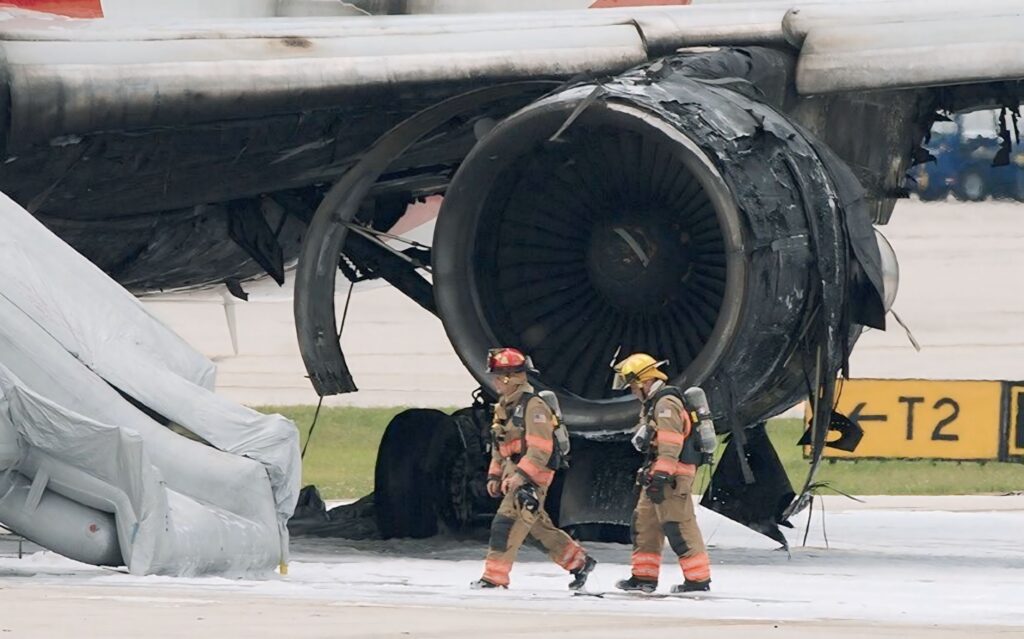
The aftermath of an engine failure and fire on a large commercial aircraft is always striking, and this image captures that reality clearly. The aircraft, likely a Boeing or Airbus, sits on the ground at an airport with one engine visibly torn apart. What remains of the nacelle is charred and misshapen, with melted sections hanging in uneven sheets. Entire panels have been burned away or blown off, exposing the internal components that are normally sealed behind layered casings. The large fan blades, usually hidden deep inside the engine, are now exposed, bent, and darkened by heat. Their visibility alone hints at the severity of the event.
When an engine fails in this manner, it is usually sudden and violent. Modern engines are designed to contain most internal failures, but the forces generated during a high-speed malfunction can still overwhelm even well-tested structures. Whether this was a contained or uncontained failure, the visible damage suggests that the engine experienced intense mechanical stress followed by a sustained fire. The shredded nacelle edges and melted composite surfaces show that the flames burned long enough to compromise the outer skin and consume much of the protective material.
The charring pattern around the nacelle is another clue. The darkest areas sit near the point of origin, where the fire would have been hottest. Farther out, the metal shows a gradient of discoloration, shifting from pitch black to dull brown and then to heat-bleached silver. This kind of pattern often forms when a localized fire spreads outward but is eventually quenched, either by the aircraft’s onboard fire suppression system or by emergency crews once the plane is on the ground.
Engine fires don’t only damage the engine itself. The area beneath the wing typically holds fuel lines, electrical wiring, and hydraulic tubing. If the fire spreads, those systems can become compromised as well. Even after landing, heat can continue to radiate through nearby panels, warping shapes and weakening structural joints. While the image centers on the engine, the soot on the underside of the wing hints that the flames reached far enough to scorch surrounding surfaces before the fire was brought under control.
Despite how dramatic this scene looks, aircraft are built to manage these emergencies. Flight crews train regularly for engine failures, even ones accompanied by fire. Procedures guide them through shutting down the affected engine, cutting off fuel, and activating fire suppression. When the aircraft is already on the ground or near an airport, the priority becomes stopping safely and handing the fire over to airport responders.
This damaged engine is a reminder of how much energy these machines handle and how quickly things can change when something inside fails. At the same time, it highlights the safety measures and engineering margins that keep such events from escalating further. What remains in the image is not only the evidence of a violent failure, but also the proof that the aircraft stayed intact long enough for everyone to reach the ground safely.