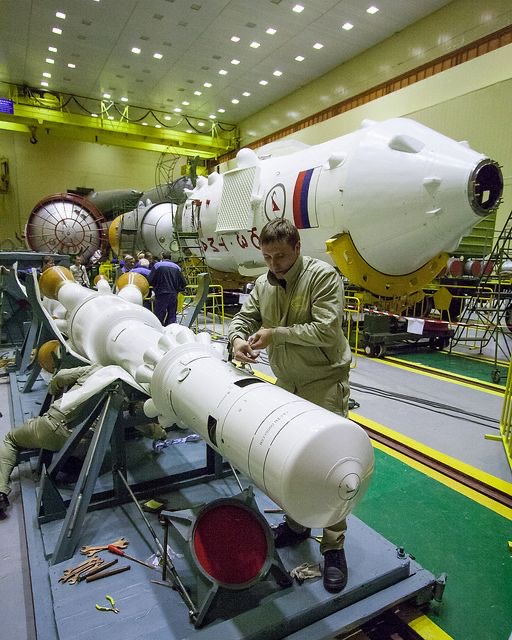
The heart of any crewed launch is the quiet, meticulous work that happens long before the rocket rolls out to the pad. That routine is where an engineer becomes more than a specialist. They’re a guardian of precision, a link in a chain that keeps astronauts safe as they head toward orbit. During Expedition 33, the Soyuz assembly process captured that balance of routine and responsibility, and the photo tagged 201210200001HQ feels like a snapshot of that world.
In the assembly hall, the Soyuz sits in sections rather than as a single spacecraft. Engineers start with the orbital module, the descent module, and the service module. Each has its own stack of wiring, plumbing, life-support hardware, and power systems that all need to be checked and cross-checked. For an engineer, the work isn’t just about making the parts fit together. It’s about verifying every small detail so nothing comes back to haunt the crew days or weeks later.
The descent module draws the most attention. It’s the only part that returns to Earth, which means it holds the seats, displays, parachutes, and the heat shield. During Expedition 33 preparations, engineers worked through established procedures that date back decades. They inspected the pressure shell, confirmed the integrity of the heat shield, and verified the seat-liner fits for the crew. Nothing is assumed. Even familiar components are treated like they’re being tested for the first time.
Once the three modules are connected, the Soyuz starts to look like a spacecraft rather than a collection of hardware. This is when teams run electrical tests, simulate communication links, and confirm that guidance and navigation systems respond exactly as expected. Any abnormal reading triggers a pause until the cause is understood. An engineer’s mindset here is almost surgical. You move slowly, think carefully, and trust both your training and your colleagues.
The integration with the rocket’s upper stage adds another layer of responsibility. The spacecraft becomes part of a much larger system, and both sides have to work together flawlessly. Engineers check the mechanical interface, run power-up sequences, and ensure the pyrotechnic devices used during separation are correctly installed. It’s a reminder that much of spaceflight depends on hardware most people never see.
On the floor, the atmosphere is a mix of focus and familiarity. Engineers often know each other well because these teams work together cycle after cycle. They rely on practiced communication, quiet notes, and steady routines. Even though the Soyuz has a reputation for reliability, that reputation exists because people treat each mission as if it’s the first.
Looking back at Expedition 33’s preparation work, it’s easy to see how the engineer’s role ties everything together. Their job is a bridge between design and reality. They carry the responsibility of making sure every bolt is torqued, every connector is locked, and every system reacts the way it should before the capsule leaves the assembly hall.
The astronauts get the attention on launch day, but the engineers are the ones who build the confidence that lets them climb aboard.