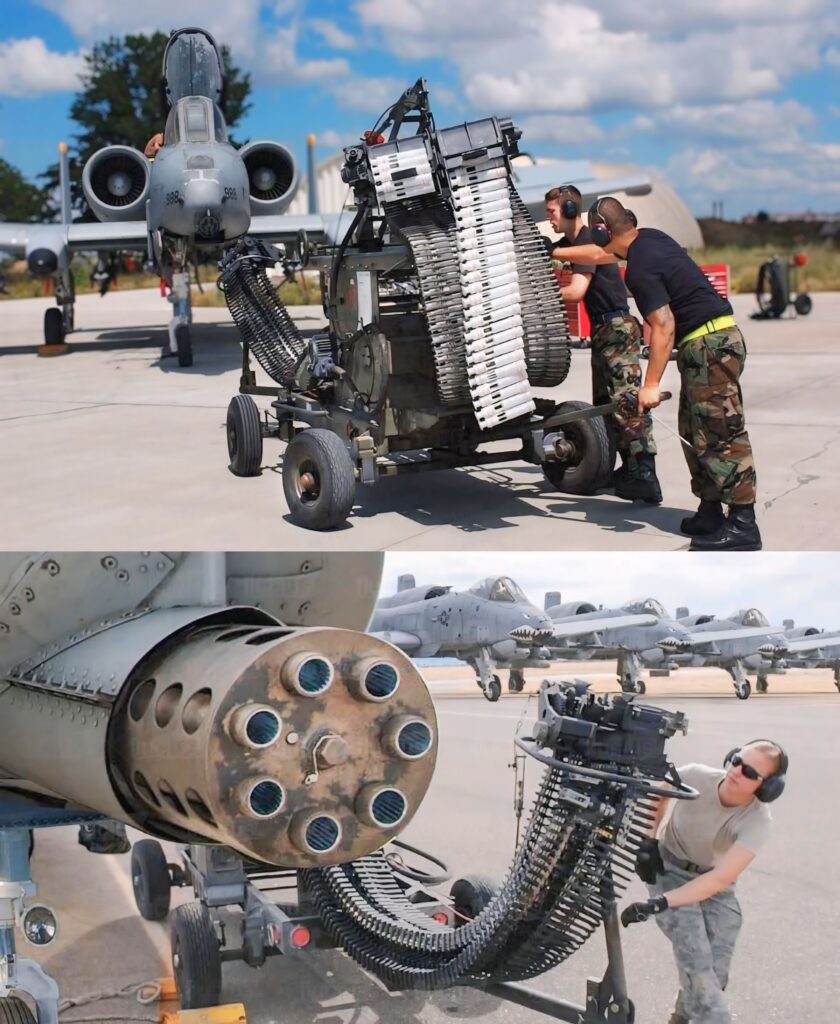
The GAU-8/A Avenger isn’t just a cannon bolted to an aircraft. It’s the core idea around which the A-10 Thunderbolt II was designed. When the U.S. Air Force set out to build a jet that could stop tanks and survive punishment close to the ground, the starting point wasn’t the airframe. It was the gun.
The GAU-8/A is a seven-barrel, 30 mm Gatling-type cannon capable of firing about 3,900 rounds per minute. That volume of fire, combined with the weight and construction of its armor-piercing ammunition, allows it to shred armored vehicles in a way no other aircraft gun of its era could match. Each round is roughly the size of a milk bottle, and the armor-piercing variant uses a depleted-uranium penetrator that stays stable at high velocity and bites through steel with ease. At the distances the A-10 fights, the rounds hit with enough force to crack open the top armor of tanks and armored personnel carriers.
Designing an airplane around a gun like that required compromises and unusual solutions. The Avenger is more than 19 feet long and weighs around 4,000 pounds with its ammunition drum. To keep the aircraft balanced, the cannon sits slightly off center, while the massive drum occupies most of the fuselage’s forward section. The front landing gear had to be moved to the right side of the nose so the gun could sit low and fire almost directly along the aircraft’s centerline. If you pull the gun from the A-10, the front of the jet looks strangely empty because so much of the aircraft’s internal space exists simply to support it.
Firing the GAU-8/A is not a mild event. The recoil is comparable to the thrust of one of the A-10’s engines. Engineers accounted for that by mounting the cannon in a way that directs the force straight through the aircraft’s structure instead of twisting it. Even then, pilots feel the jet slow slightly when they squeeze the trigger. The aircraft’s engines sit high and far apart to keep debris from entering them during low-altitude gun runs, and the airframe is built tough enough to absorb the stresses of repeated firing passes while flying close to the ground.
All of these details point back to one purpose: delivering the Avenger onto the battlefield and giving pilots the confidence to use it at point-blank range. The A-10’s armor, redundancy, big wings and long loiter time make sure the jet can stay in the fight, but the GAU-8/A is the tool that closes the deal. In cold numbers, the gun was designed to kill tanks. In practice, it has done that and more, becoming a psychological presence for ground forces who trust its accuracy and power.
In the end, the A-10 is famous, but the reason it exists is simple. The Air Force needed a flying platform that could carry the GAU-8/A Avenger. Everything else came after.