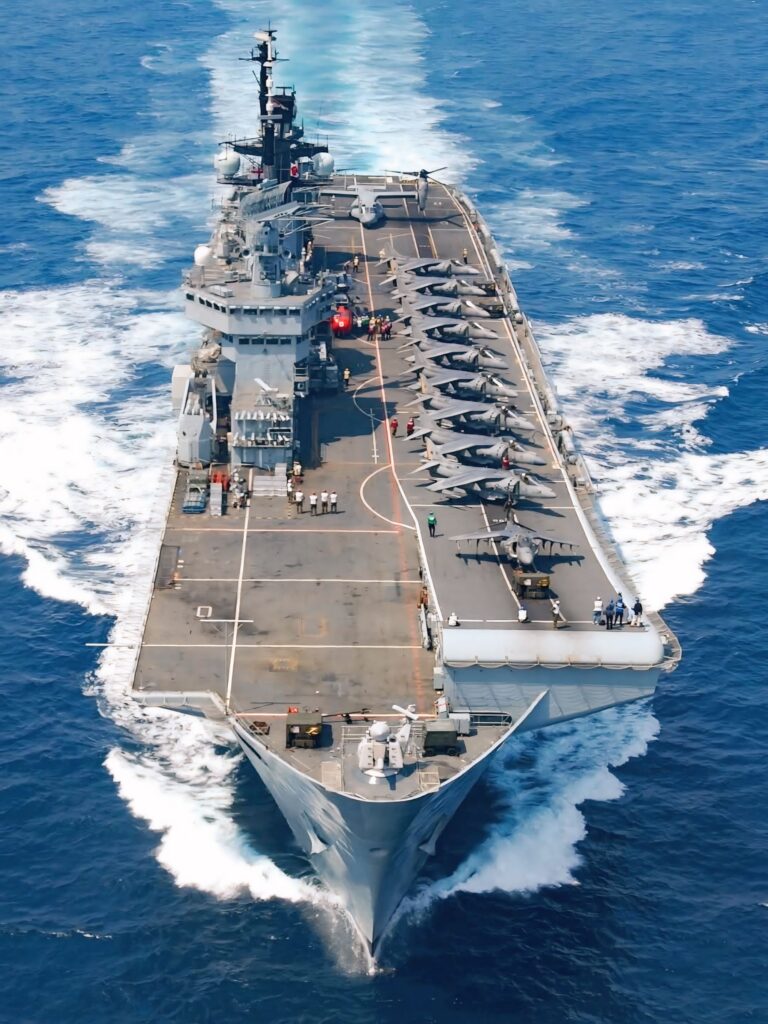
Based on the available visual evidence, the ship in question can be confidently identified as the ITS Cavour (C 550), the flagship of the Italian Navy, known as the Marina Militare. Several distinctive design features and structural elements align closely with publicly documented characteristics of this vessel, supporting this identification with a high degree of certainty.
The ITS Cavour is an aircraft carrier designed to serve as the centerpiece of Italy’s naval power. One of the most recognizable visual indicators is its full-length flight deck, which includes a ski jump ramp at the bow. This ramp is specifically engineered to support short takeoff and vertical landing aircraft, such as the AV-8B Harrier II and the newer F-35B Lightning II. The presence of this ski jump is a key identifying feature, as relatively few navies operate carriers with this configuration, and the Italian Navy is among them.
Another strong visual cue is the ship’s island superstructure. On the Cavour, the island is compact, angular, and positioned on the starboard side of the flight deck. It integrates radar arrays, communications equipment, and the ship’s command facilities in a single, cohesive structure. The shape and layout of this island match well with known images and schematics of the ITS Cavour, distinguishing it from other European carriers such as those operated by France or the United Kingdom, which feature different island designs and proportions.
The overall size and proportions of the vessel also support this conclusion. The Cavour measures approximately 244 meters in length and displaces around 27,000 tons at full load. Visually, this places it in the category of a medium-sized aircraft carrier, larger than amphibious assault ships but smaller than the supercarriers operated by the United States. This balance between size and capability is a hallmark of Italian naval doctrine, which emphasizes flexibility, regional presence, and expeditionary operations.
Additional visual details, such as deck markings, elevator placement, and hull form, further reinforce the identification. The Cavour features aircraft elevators positioned to maximize deck space while allowing efficient movement between the hangar and flight deck. The hull itself has a clean, modern profile, reflecting its relatively recent construction and subsequent modernization to support fifth-generation aircraft.
As the flagship of the Marina Militare, the ITS Cavour plays a central role beyond combat operations. It serves as a command and control platform, a symbol of national maritime capability, and a tool for humanitarian assistance and disaster relief. Its design reflects this multifunctional role, combining aviation facilities with hospital spaces and the ability to support joint and allied operations.
In conclusion, the combination of a ski jump flight deck, distinctive island superstructure, proportional size, and modern design features strongly indicates that the ship observed is the ITS Cavour (C 550). These visual elements align precisely with known characteristics of Italy’s flagship aircraft carrier, leaving little doubt as to its identity.