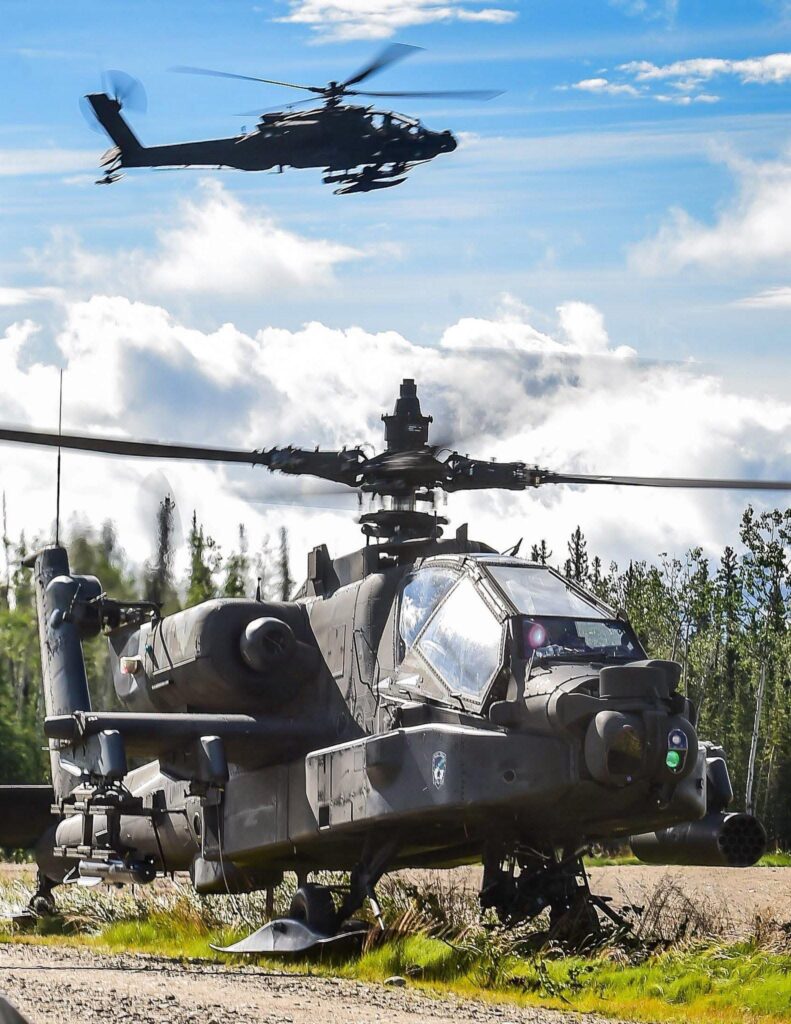
Near Fort Greely, Alaska, the presence of U.S. Army AH-64 Apache attack helicopters represents a visible reminder of how modern military aviation adapts to some of the most demanding environments on earth. Fort Greely sits in the Interior of Alaska, an area known for extreme cold, long winters, and vast, open terrain. Operating advanced rotary-wing aircraft in this region requires a mix of technical capability, disciplined training, and constant attention to the realities of Arctic conditions.
The AH-64 Apache is best known for its role as a heavily armed attack helicopter, designed to provide close air support, armed reconnaissance, and force protection. Equipped with a 30mm chain gun, precision-guided missiles, and advanced targeting systems, the Apache is built to operate day or night and in adverse weather. Near Fort Greely, those features are tested in ways that differ from more temperate locations. Bitter cold affects everything from engine performance to hydraulic systems, while snow-covered terrain can make visual navigation difficult even for experienced crews.
Training flights in the area often focus on cold-weather operations, low-level flying, and coordination with ground units. Pilots and crew members must account for limited daylight during winter months and rapidly changing weather patterns. Whiteout conditions, high winds, and extreme temperatures are not occasional challenges but regular factors that shape mission planning. The Apache’s sensors and avionics provide a significant advantage, but they do not replace the need for judgment and experience in such an environment.
Fort Greely is best known for its role in U.S. missile defense, but the surrounding airspace also supports a wide range of Army aviation activities. Apaches operating near the installation help maintain readiness for operations across Alaska and beyond. The state’s size allows crews to train over long distances, practicing extended missions that mirror real-world scenarios where logistics, fuel management, and coordination are critical.
Cold-weather maintenance is another major aspect of Apache operations near Fort Greely. Ground crews work in harsh conditions to ensure aircraft remain mission-ready. Metal becomes brittle in extreme cold, fluids behave differently, and even routine inspections take more time. These challenges reinforce the importance of skilled maintainers, whose work is as vital as that of the aircrews.
Beyond training value, the presence of AH-64 Apaches in Alaska carries strategic significance. The ability to deploy and operate advanced combat aircraft in the Arctic underscores the Army’s commitment to defending U.S. interests in the region. As the Arctic gains greater attention for its strategic location and resources, maintaining credible and capable forces there becomes increasingly important.
In the skies near Fort Greely, the Apache is more than a weapon system. It is a platform that reflects adaptability, preparation, and resilience. Flying over frozen forests and open tundra, these helicopters and their crews demonstrate how modern military aviation meets the demands of one of the world’s toughest operating environments, while remaining ready for missions wherever they may be needed.