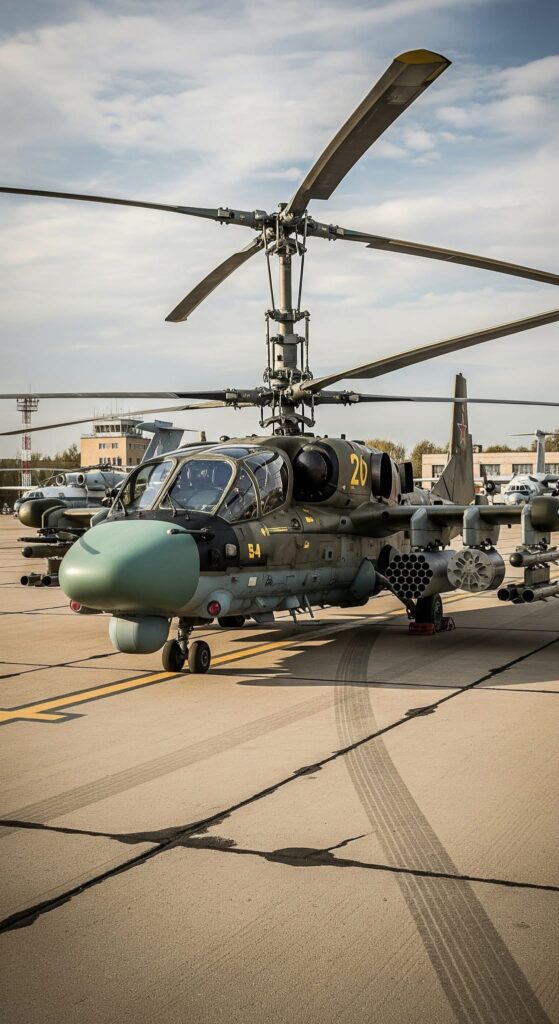
The Ka-52, often called the Alligator, is a Russian attack helicopter designed for modern battlefield conditions where speed, awareness, and firepower matter as much as survivability. It is a development of the single seat Ka-50, adapted to meet the need for a two crew configuration that improves coordination, target acquisition, and mission flexibility. Since entering service, the Ka-52 has become one of the most recognizable rotary wing combat aircraft in use today.
One of the Ka-52’s defining features is its coaxial rotor system. Instead of a single main rotor and a tail rotor, it uses two counter rotating rotors mounted on the same axis. This design removes the need for a tail rotor and allows the helicopter to deliver more power directly to lift and maneuvering. As a result, the Ka-52 has excellent agility, particularly in tight airspace and at low altitudes. It can perform sharp turns, rapid climbs, and stable hovering even in strong crosswinds, which is valuable during attack runs and reconnaissance missions.
The cockpit layout is another key difference. The Ka-52 places its two crew members side by side rather than in tandem. This arrangement improves communication and shared situational awareness, especially during complex missions that involve coordination with ground forces or other aircraft. Both crew members have access to flight controls, displays, and targeting systems, which allows either pilot to take over if necessary. The cockpit is also heavily armored and equipped with an ejection seat system, a rare feature for helicopters, designed to increase crew survivability.
In terms of sensors and avionics, the Ka-52 is built for all weather, day and night operations. It carries electro optical systems, thermal imaging, laser rangefinders, and radar, depending on configuration. These systems allow the helicopter to detect, track, and engage targets at long range while remaining relatively concealed. Data links enable it to share information with other aircraft and command units, making it more effective as part of a coordinated force rather than acting alone.
The Ka-52’s armament reflects its role as a multi purpose attack platform. It is typically equipped with a 30 mm cannon mounted on the side of the fuselage, along with a range of guided and unguided weapons. These include anti tank missiles, rockets, and air to air missiles for self defense. This combination allows the Ka-52 to engage armored vehicles, fortified positions, infantry, and low flying aerial threats.
Overall, the Ka-52 represents a distinct approach to attack helicopter design. Its coaxial rotors, side by side cockpit, and emphasis on maneuverability set it apart from many Western counterparts. While combat experience has highlighted both strengths and limitations, the Ka-52 remains a significant example of how design choices reflect specific tactical and operational philosophies in modern military aviation.