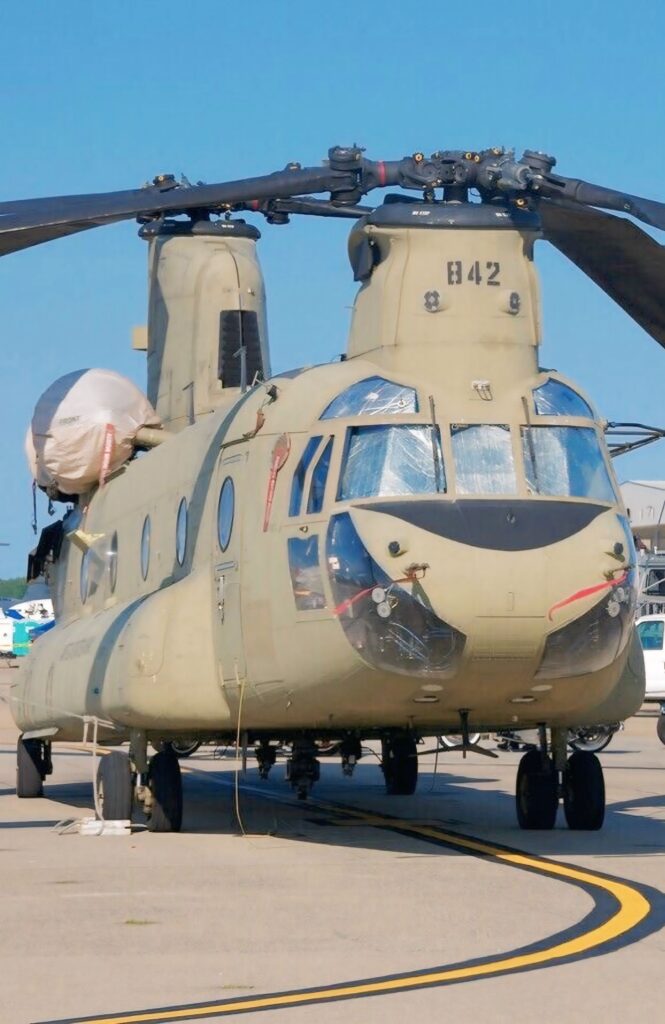
The Boeing CH-47 Chinook is one of the most recognizable and enduring military helicopters in service today. First introduced in the early 1960s, the Chinook was designed to meet the need for a heavy-lift helicopter capable of transporting troops, artillery, vehicles, and supplies in demanding conditions. More than six decades later, it remains a cornerstone of military logistics and air mobility for armed forces around the world.
The Chinook’s most distinctive feature is its tandem-rotor configuration, with two large rotors mounted fore and aft. This design removes the need for a tail rotor and allows more engine power to be devoted to lift rather than directional control. As a result, the CH-47 can carry heavier loads and operate efficiently in hot, high, and rugged environments where other helicopters struggle. Its wide fuselage and rear loading ramp make it well suited for moving oversized cargo, including light armored vehicles and artillery pieces.
Powered by twin turboshaft engines, modern Chinook variants can reach speeds of over 300 kilometers per hour, making them among the fastest helicopters of their class. They also have impressive range and endurance, especially when equipped with auxiliary fuel tanks or in-flight refueling capability. These qualities allow the Chinook to support long-distance missions, from battlefield resupply to disaster relief operations.
The CH-47 has seen extensive combat service, most notably during the Vietnam War, where it earned a reputation for reliability under fire. Since then, it has been deployed in conflicts and peacekeeping missions across the Middle East, Europe, and Asia. Beyond combat, the Chinook has played a critical role in humanitarian missions, delivering food, evacuating civilians, and transporting emergency equipment after earthquakes, floods, and other natural disasters.
Over the years, Boeing has continued to modernize the Chinook to meet evolving operational needs. The latest variants feature advanced avionics, digital flight controls, improved defensive systems, and more powerful engines. These upgrades enhance safety, reduce pilot workload, and extend the aircraft’s service life well into the future. Many operators are expected to fly the Chinook into the 2040s and beyond.
Another reason for the Chinook’s longevity is its adaptability. It can be configured for troop transport, cargo lift, medical evacuation, or special operations with minimal changes. This flexibility makes it a valuable asset for both military planners and commanders in the field, who rely on it for a wide range of missions.
In summary, the Boeing CH-47 Chinook is far more than a legacy aircraft. It is a proven, continuously evolving platform that combines power, speed, and versatility. Its long service record reflects not only solid engineering but also its ongoing relevance in modern military and humanitarian operations. Few aircraft have matched the Chinook’s impact, and fewer still have remained as essential for as long.