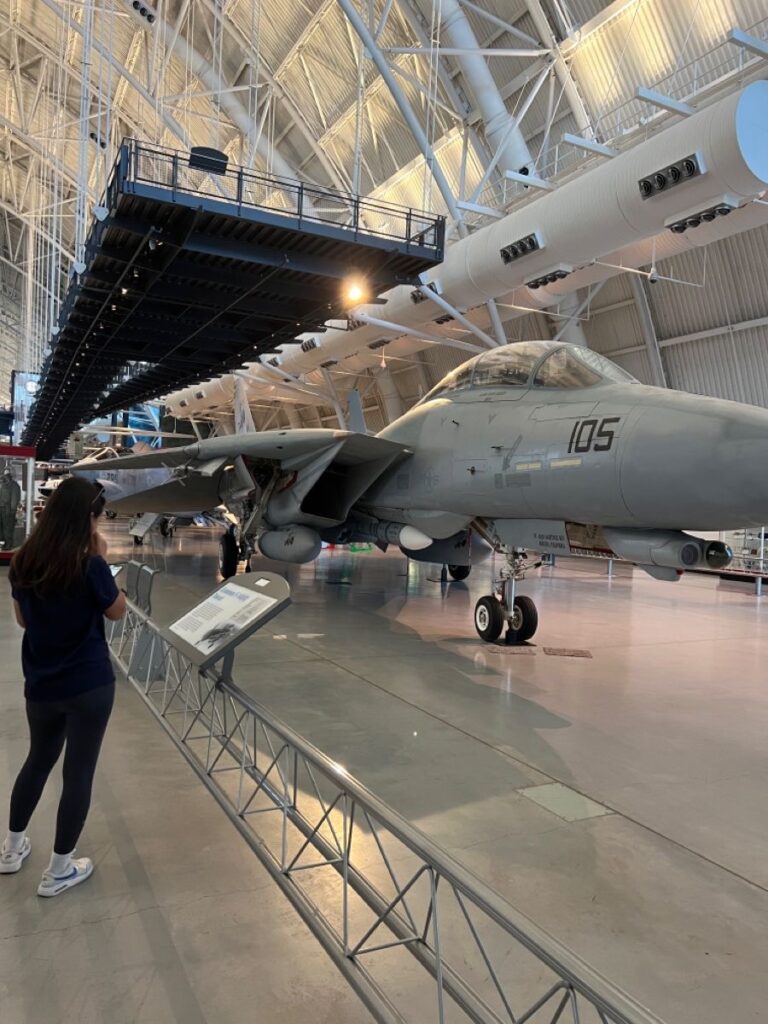
The F-14D Super Tomcat was the most advanced and capable version of the legendary Grumman F-14, a fighter aircraft that became a symbol of United States naval aviation. Designed to defend carrier battle groups from long range threats, the F-14D represented the peak of the Tomcat’s long development, combining proven airframe design with modern electronics, sensors, and engines.
The Super Tomcat retained the F-14’s distinctive variable sweep wings, a feature that allowed the aircraft to perform well across a wide range of speeds. With wings swept forward, the aircraft could operate safely at low speeds during carrier takeoffs and landings. When swept back, the Tomcat achieved high speed and excellent stability during intercept missions. This adaptability made the F-14 uniquely suited to the demanding environment of carrier operations.
One of the most important improvements in the F-14D was its avionics suite. Earlier versions relied heavily on analog systems, but the D model introduced a fully digital cockpit. The pilot and radar intercept officer benefited from improved displays, better data processing, and greater situational awareness. At the heart of the Super Tomcat was the AN/APG-71 radar, derived from the F-15’s APG-70. This radar offered better reliability, longer detection range, and improved tracking of multiple targets compared to earlier systems.
The F-14D was powered by General Electric F110 engines, which solved many of the reliability and performance issues associated with the older Pratt and Whitney TF30 engines. The new engines provided more thrust, faster acceleration, and improved safety during carrier launches and recoveries. These engines transformed the aircraft’s handling, giving pilots greater confidence during demanding maneuvers.
In terms of armament, the Super Tomcat remained a formidable weapons platform. It could carry the AIM-54 Phoenix long range missile, capable of engaging multiple targets at extreme distances. In addition, it supported AIM-7 Sparrow and AIM-9 Sidewinder missiles, along with a 20 mm M61 Vulcan cannon. As the Navy’s mission focus shifted after the Cold War, the F-14D was adapted for precision strike roles. It could carry laser guided bombs and use targeting pods, allowing it to perform ground attack missions alongside its air defense duties.
Despite its impressive capabilities, the F-14D arrived during a period of shrinking defense budgets and changing strategic priorities. The aircraft was expensive to maintain and required significant manpower to keep operational. As a result, production was limited, and the Navy eventually chose to retire the Tomcat in favor of the more modern and cost effective F/A-18E/F Super Hornet.
The F-14D Super Tomcat stands today as the ultimate expression of a famous aircraft line. It combined raw power, advanced technology, and versatility in a way few fighters have matched. While it no longer flies in U.S. service, the Super Tomcat remains an enduring symbol of naval air power and engineering ambition.