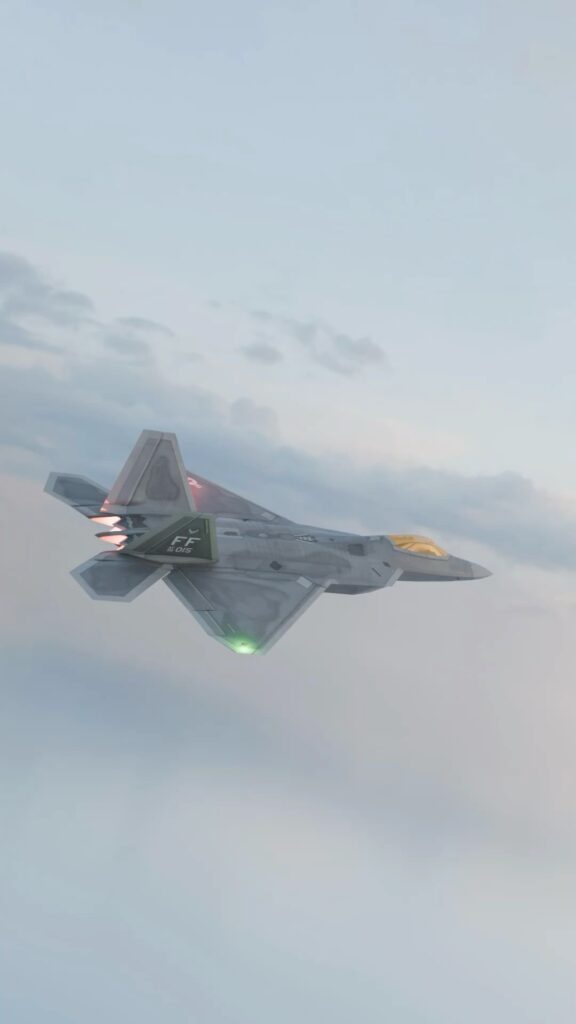
The F-22 Raptor is one of the most advanced fighter aircraft ever built. Developed by the United States, it represents a major leap in air combat technology and remains a symbol of modern military aviation. Designed primarily as an air superiority fighter, the F-22 also has the ability to perform ground attack, electronic warfare, and intelligence missions. Its combination of speed, stealth, agility, and situational awareness sets it apart from any other operational fighter jet.
One of the defining features of the F-22 Raptor is its stealth. The aircraft is shaped and coated with special materials that reduce its radar signature, making it extremely difficult for enemy systems to detect and track. Unlike older fighters that rely on speed or altitude alone for survival, the F-22 is built to avoid detection in the first place. This allows it to enter contested airspace, engage targets, and leave before opponents are even aware it was there.
Speed and maneuverability are also central to the Raptor’s design. The F-22 can cruise at supersonic speeds without using afterburners, a capability known as supercruise. This gives it a major advantage in both fuel efficiency and combat performance. In close-range engagements, thrust-vectoring engines allow the aircraft to perform sharp turns and complex maneuvers that few other jets can match. These qualities make the F-22 dominant in both long-range and dogfight scenarios.
Equally important is the aircraft’s advanced avionics. The F-22 does not simply gather information, it processes and integrates data from multiple sensors to give the pilot a clear and accurate picture of the battlespace. Radar, electronic surveillance, and communication systems work together seamlessly. This allows pilots to detect threats, identify targets, and coordinate with other aircraft in real time. The result is faster decision-making and a significant tactical advantage.
Despite its impressive capabilities, the F-22 program has faced criticism. The aircraft is expensive to build and maintain, and production was limited to fewer than 200 units. As a result, it is no longer in production, and the existing fleet must be carefully managed to remain effective for decades. Critics argue that newer, more affordable platforms could offer greater flexibility. Supporters counter that no other aircraft can fully replace the F-22’s air dominance role.
In service, the F-22 Raptor has helped maintain air superiority for the United States and its allies. Even without seeing frequent combat, its presence alone acts as a powerful deterrent. Potential adversaries must plan around its capabilities, knowing they face an aircraft that is extremely hard to detect and even harder to defeat.
In conclusion, the F-22 Raptor is more than just a fighter jet. It is a statement of technological leadership and military capability. While its future will eventually give way to newer systems, its impact on modern air combat will be felt for many years to come.