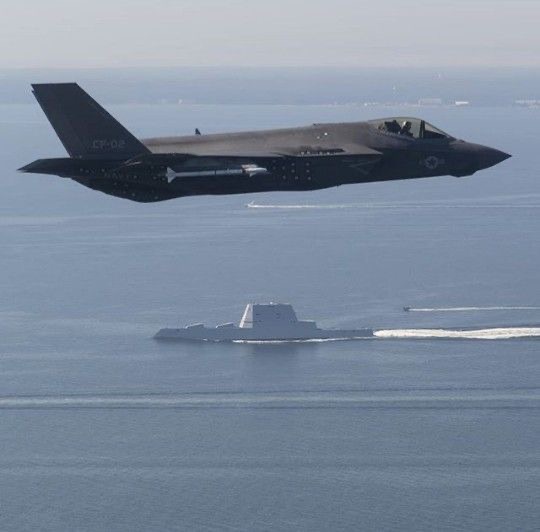
The F-35 Lightning II is one of the most advanced and debated combat aircraft of the modern era. Designed as a fifth-generation, multirole fighter, it was built to meet the needs of the United States and its allies in an age where air superiority depends as much on information and connectivity as on speed and firepower. Unlike earlier fighters that focused on a single role, the F-35 was developed to perform air-to-air combat, ground attack, intelligence gathering, and electronic warfare within one integrated platform.
At the core of the F-35’s design is stealth. Its shape, materials, and internal weapons bays are all engineered to reduce radar detection, allowing it to operate deep inside contested airspace. This low observability gives pilots the ability to see and act before an adversary is even aware of their presence. Stealth, however, is only one part of the equation. The F-35 is also built around sensor fusion, a concept that brings together data from radar, infrared sensors, electronic surveillance systems, and off-board sources. Instead of overwhelming the pilot with raw data, the aircraft’s computers process and present a clear, unified picture of the battlespace.
The F-35 family includes three main variants, each tailored to different operational needs. The F-35A is the conventional takeoff and landing version used primarily by air forces. The F-35B features short takeoff and vertical landing capability, making it suitable for amphibious ships and austere airfields. The F-35C is designed for aircraft carrier operations, with larger wings and stronger landing gear. Despite these differences, all variants share a high degree of commonality, which helps streamline training, maintenance, and logistics across services and allied nations.
One of the aircraft’s most significant strengths is its role as a force multiplier. The F-35 is not just a shooter but also a node in a larger network. It can collect, analyze, and share information with other aircraft, ships, ground forces, and command centers in real time. In many scenarios, the F-35 may identify and track threats, then pass targeting data to other platforms better positioned to engage. This ability to connect and coordinate makes it especially valuable in joint and coalition operations.
Despite its capabilities, the F-35 program has faced criticism. High development costs, delays, and maintenance challenges have raised questions about affordability and long-term sustainability. Supporters argue that many of these issues are typical of complex, cutting-edge programs and that costs have decreased as production has scaled up. They also point out that the aircraft’s capabilities are difficult to replicate with older platforms, even in large numbers.
In today’s strategic environment, the F-35 represents a shift in how air power is applied. It emphasizes information dominance, survivability, and integration across domains. While debate about its cost and complexity continues, there is little doubt that the F-35 has reshaped expectations for modern fighter aircraft and will remain a central element of air combat operations for decades to come.