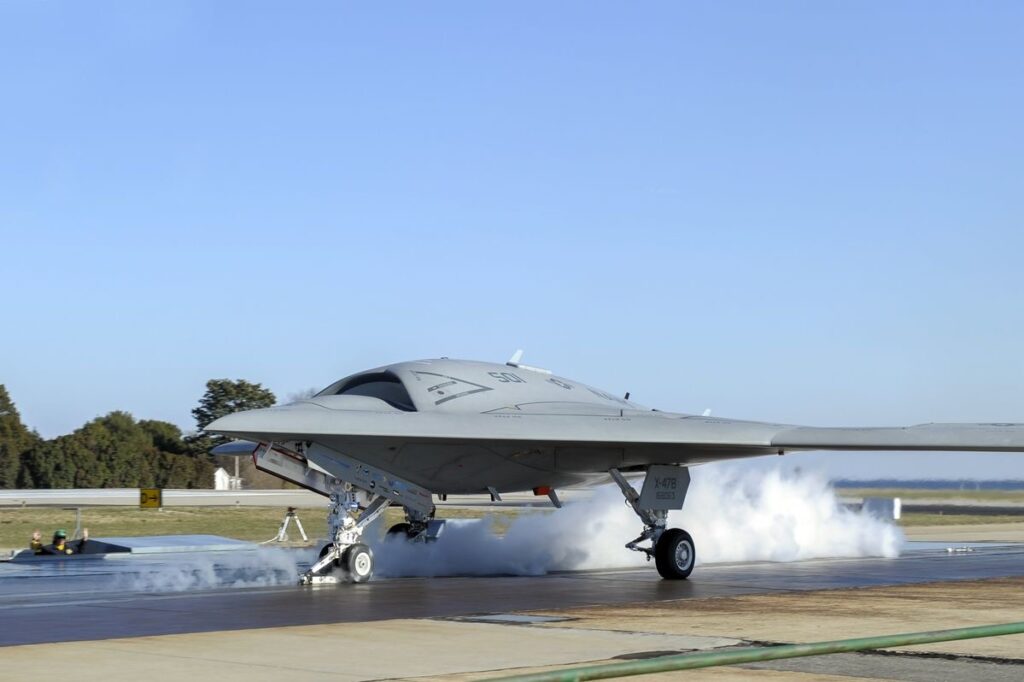
The Northrop Grumman X-47B is significant because it marked a turning point in naval aviation and unmanned flight. Developed by Northrop Grumman for the United States Navy, the X-47B was not just another drone. It was designed to demonstrate that a tailless, jet-powered, autonomous aircraft could safely and effectively operate from an aircraft carrier. That achievement reshaped expectations about the future of combat aviation.
One of the most important milestones came in 2013, when the X-47B became the first unmanned aircraft to successfully launch from and land on a nuclear-powered aircraft carrier. Carrier operations are among the most demanding tasks in aviation. Pilots must land on a moving deck that is pitching and rolling at sea, often at night and in poor weather. For decades, this challenge was considered too complex for autonomous systems. The X-47B proved otherwise. Its precision landings demonstrated that advanced sensors, satellite navigation, and onboard computers could perform at a level once reserved for highly trained naval aviators.
Another major contribution of the X-47B was its role in advancing autonomous flight technology. Unlike remotely piloted drones that rely on constant human input, the X-47B was designed to operate with a high degree of independence. It could follow pre-programmed mission plans, adjust to changing conditions, and execute carrier approaches with minimal real-time control from operators. This level of autonomy highlighted how artificial intelligence and automation could be integrated into military aviation, reducing pilot workload and potentially lowering risk in high-threat environments.
The aircraft’s design also reflected modern stealth principles. Its blended wing body and lack of vertical tails reduced radar visibility, aligning it with the evolving demands of contested airspace. While the X-47B was a demonstrator and not an operational combat aircraft, it showed that unmanned systems could incorporate the same low-observable features found in advanced manned fighters and bombers. That opened the door to future carrier-based unmanned strike aircraft capable of penetrating defended areas.
The X-47B program influenced the Navy’s long-term strategy. Although the original Unmanned Combat Air System concept shifted toward aerial refueling capabilities, the lessons learned directly contributed to the development of the Boeing MQ-25 Stingray. The MQ-25 now extends the range of carrier air wings by providing mid-air refueling, a mission made feasible in part because the X-47B proved unmanned aircraft could integrate safely with carrier operations.
Beyond its technical achievements, the X-47B changed perceptions. It demonstrated that unmanned aircraft were not limited to surveillance or land-based strike roles. They could function in the most demanding naval environment and operate alongside crewed jets. This shift signaled a broader transformation in military doctrine, where human pilots and autonomous systems increasingly work together as part of a networked force.
In the broader history of aviation, the X-47B stands as a bridge between traditional carrier aviation and the future of autonomous air power. Its successful demonstrations did not simply test new hardware. They validated a concept that will likely shape naval air operations for decades to come.