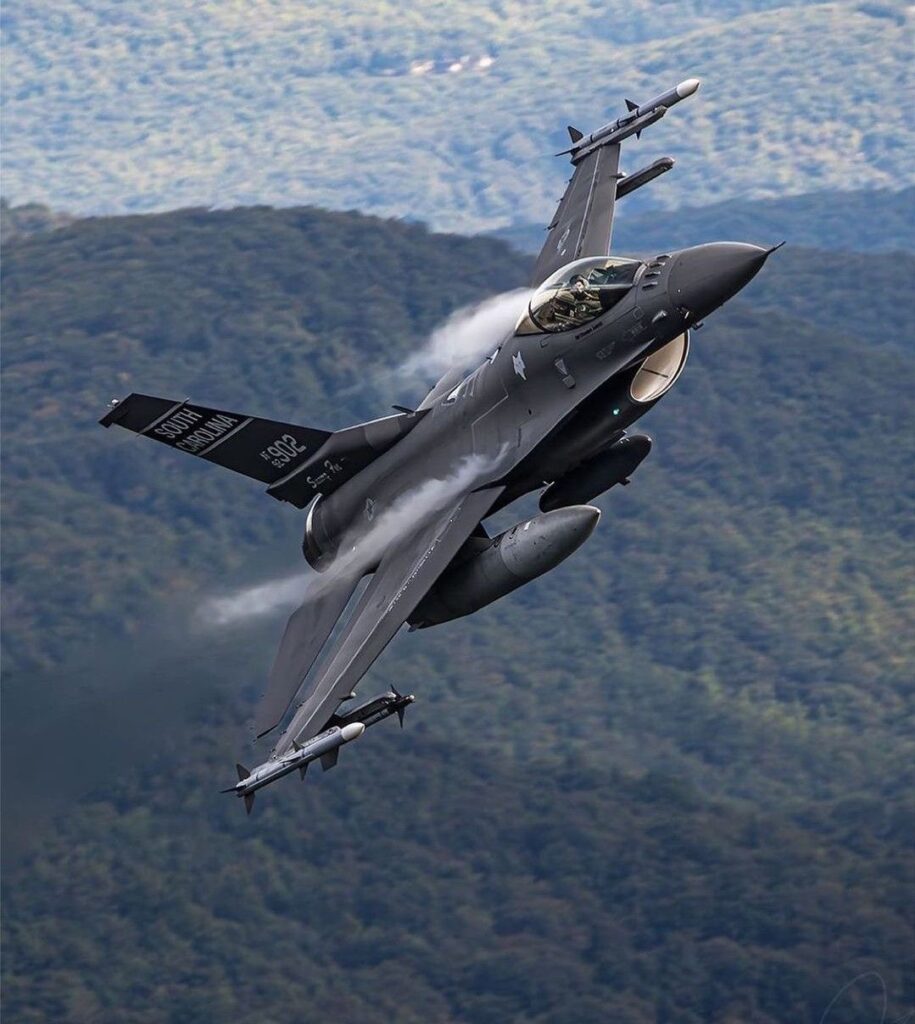
The F-16 Fighting Falcon is one of the most successful and widely used multirole fighter aircraft in modern aviation history. Developed in the 1970s by General Dynamics for the United States Air Force, the F-16 was designed to be a lightweight, highly maneuverable air superiority fighter. Over time, it evolved into a versatile platform capable of performing a wide range of missions, including air combat, ground attack, and reconnaissance. Today, it remains a key component of air forces around the world.
The program began as part of the U.S. Air Force’s Lightweight Fighter initiative, which aimed to create a cost-effective aircraft that could outperform heavier fighters in dogfights. The first prototype flew in 1974, and the aircraft officially entered service in 1978. What set the F-16 apart from earlier fighters was its emphasis on agility and pilot visibility. Its bubble canopy provides excellent all-around vision, while its frameless design reduces blind spots. The aircraft also introduced a side-mounted control stick and a reclined seat to improve pilot comfort and reduce the effects of high G-forces during intense maneuvers.
One of the F-16’s most distinctive features is its fly-by-wire flight control system. Instead of relying on traditional mechanical linkages, the aircraft uses electronic signals to transmit pilot inputs to the control surfaces. This allows for greater precision and stability, particularly at high speeds and extreme angles of attack. The F-16 is intentionally designed to be aerodynamically unstable, which enhances maneuverability. The fly-by-wire system constantly makes adjustments to keep the aircraft balanced and responsive.
Powered by a single turbofan engine, the F-16 is capable of reaching speeds exceeding Mach 2. It has a combat radius suitable for both defensive and offensive missions, and it can carry a wide variety of weapons on multiple hardpoints under its wings and fuselage. These include air-to-air missiles, air-to-ground munitions, precision-guided bombs, and a 20 mm internal cannon. Its adaptability has allowed it to serve in numerous conflicts, from the Cold War era to more recent operations in the Middle East and elsewhere.
The aircraft has undergone continuous upgrades over the decades. Modern variants feature advanced radar systems, improved avionics, and enhanced weapons integration. These upgrades have kept the F-16 relevant even as newer fifth-generation fighters enter service. Many nations have chosen the F-16 for its balance of performance, reliability, and cost-effectiveness. More than 4,500 units have been produced, making it one of the most widely built jet fighters in history.
Beyond its combat record, the F-16 has also become a symbol of modern air power. It is used by air demonstration teams, including the U.S. Air Force Thunderbirds, showcasing its agility and performance capabilities to audiences around the world. Decades after its introduction, the F-16 Fighting Falcon continues to prove its value. Its combination of speed, flexibility, and technological innovation ensures that it remains a cornerstone of global air forces and a benchmark in fighter aircraft design.