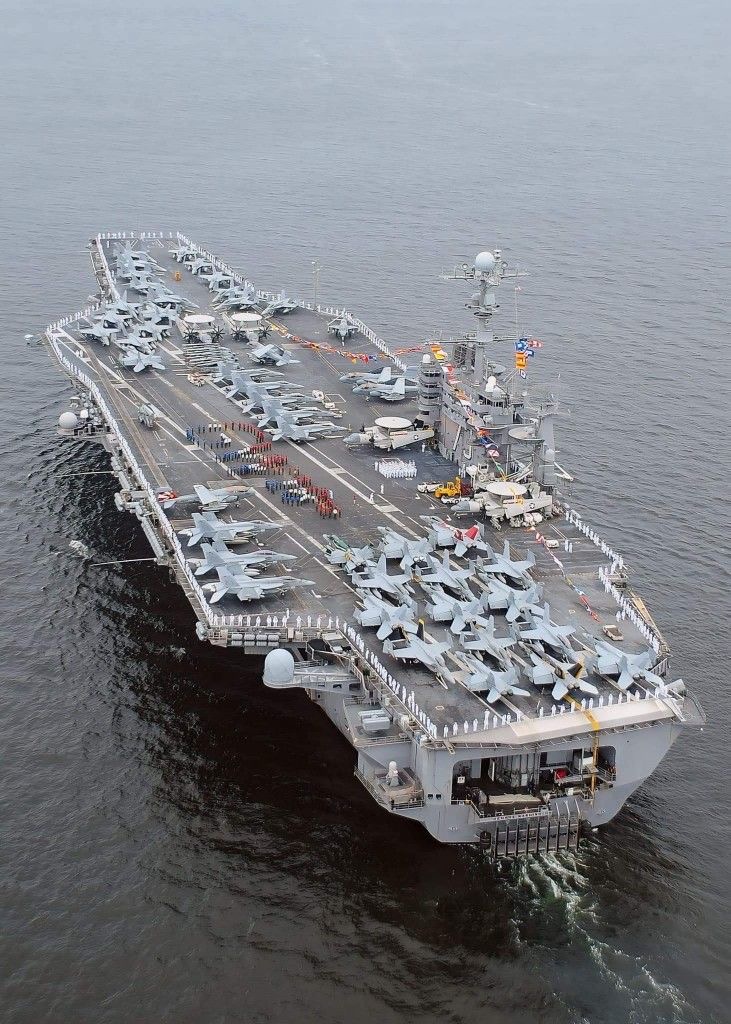
The USS George H.W. Bush (CVN-77) is one of the most advanced aircraft carriers ever built by the United States Navy. As the tenth and final ship of the Nimitz-class aircraft carrier, it represents the culmination of decades of technological development in naval aviation and carrier design. Commissioned in 2009, the ship was named in honor of George H. W. Bush, who served as a naval aviator during World War II and later became the 41st President of the United States.
The USS George H.W. Bush is powered by two nuclear reactors, allowing it to operate for more than 20 years without refueling. This nuclear propulsion gives the ship a virtually unlimited range, enabling it to travel across the world’s oceans without relying on traditional fuel supplies. The carrier is approximately 1,092 feet (333 meters) long and displaces over 100,000 tons when fully loaded. With a crew of more than 5,000 sailors and air personnel, it functions as a floating military base capable of launching and recovering dozens of aircraft.
One of the defining features of the Nimitz-class carriers is their ability to support large air wings. The USS George H.W. Bush can carry around 60 aircraft, including fighter jets, early warning aircraft, electronic warfare planes, and helicopters. These aircraft allow the carrier to conduct a wide range of missions, including air superiority, strike operations, reconnaissance, and humanitarian assistance. The carrier’s flight deck, spanning more than four acres, is equipped with steam-powered catapults that launch aircraft into the air in seconds.
Although it is part of the long-running Nimitz-class design, the USS George H.W. Bush incorporates several improvements over earlier ships in the class. Its flight deck design includes a curved and slightly modernized layout that improves aircraft movement and operational efficiency. The island structure, which houses the ship’s command center and radar systems, was positioned further aft compared to previous carriers. This change created more usable space on the flight deck and improved the flow of aircraft during high-tempo operations.
The ship also includes advanced radar systems, upgraded communications technology, and improved defensive capabilities. These systems allow the carrier to operate effectively in modern combat environments where electronic warfare and missile threats are significant concerns. Like other carriers in its class, the USS George H.W. Bush is protected by escort ships such as destroyers, cruisers, and submarines, forming a powerful carrier strike group.
Since its commissioning, the USS George H.W. Bush has participated in multiple deployments and military operations. It has supported missions in the Middle East, including operations against extremist groups and efforts to maintain regional stability. In addition to combat missions, the carrier has also been involved in training exercises with allied nations, demonstrating the United States’ commitment to international security and cooperation.
Overall, the USS George H.W. Bush stands as a symbol of American naval power and technological achievement. As the final ship of the Nimitz-class aircraft carriers, it bridges the gap between earlier carrier designs and the newer Gerald R. Ford-class aircraft carrier that followed. Through its capabilities, global presence, and operational history, the USS George H.W. Bush continues to play a critical role in projecting power and maintaining security across the world’s oceans.