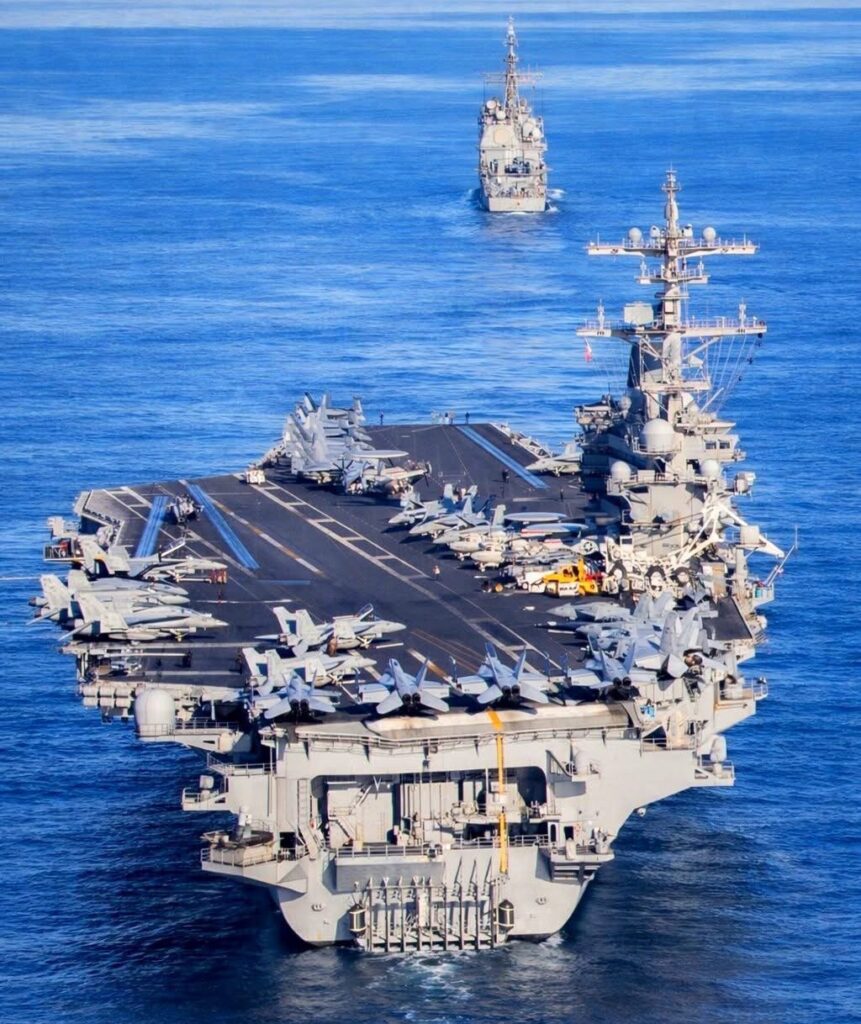
The United States is preparing to deploy a third aircraft carrier, the USS George H.W. Bush, to the Middle East, marking a significant expansion of its military presence in a region already under intense geopolitical pressure. The move reflects Washington’s growing concern about escalating tensions, regional instability, and the need to maintain a strong deterrent posture in one of the world’s most strategically sensitive areas.
The USS George H.W. Bush is a nuclear-powered aircraft carrier and one of the most advanced warships in the US Navy. As part of the Nimitz-class carriers, it serves as a floating military base capable of projecting power across vast distances. Equipped with dozens of fighter jets, surveillance aircraft, helicopters, and advanced radar systems, the carrier allows the United States to conduct air operations, intelligence missions, and rapid response operations without relying on land bases.
Deploying a third carrier strike group to the Middle East signals that the United States is taking a cautious but firm approach to regional developments. Aircraft carriers are often used not only for combat capability but also for strategic messaging. Their presence demonstrates readiness and commitment to allies while sending a warning to potential adversaries that the United States is prepared to respond quickly to any threats.
In recent months, the Middle East has faced a series of security challenges. Ongoing conflicts, maritime tensions in key shipping routes, and the activities of armed groups have raised concerns about the stability of global trade and energy supplies. The region’s waterways, particularly those connecting the Persian Gulf to international markets, remain among the most critical corridors for oil transportation. Any disruption there could have significant consequences for the global economy.
By deploying the USS George H.W. Bush, US defense officials aim to strengthen maritime security and protect commercial shipping routes. Carrier strike groups typically operate alongside destroyers, cruisers, and support vessels that provide missile defense, anti-submarine capabilities, and logistical support. Together, they form a powerful naval force capable of responding to a wide range of scenarios, from humanitarian assistance to high-intensity military operations.
Another key purpose of the deployment is reassurance. Several US allies in the region rely heavily on American security partnerships. The presence of additional naval assets helps reassure those partners that the United States remains committed to maintaining regional stability. Military cooperation, joint exercises, and coordinated patrols often increase when a carrier group enters the region.
However, such deployments are not without risks. Increasing military presence can also raise tensions if rival powers interpret it as an escalation. For that reason, US officials typically emphasize that the deployment is defensive and aimed at deterrence rather than confrontation. Diplomacy and communication channels remain critical to preventing misunderstandings or unintended conflict.
The USS George H.W. Bush carrier strike group will likely conduct operations across several parts of the region, including international waters that serve as vital transit routes for global trade. The carrier’s air wing can provide surveillance coverage over vast areas, helping monitor potential threats and supporting coalition forces if needed.
Ultimately, the decision to send a third aircraft carrier highlights how seriously Washington views current developments in the Middle East. While military power alone cannot resolve complex regional issues, it remains a key tool for maintaining stability and protecting strategic interests. As the USS George H.W. Bush begins its mission, the deployment will be closely watched by allies and rivals alike, reflecting the continuing importance of the Middle East in global security calculations. 🌍⚓✈️