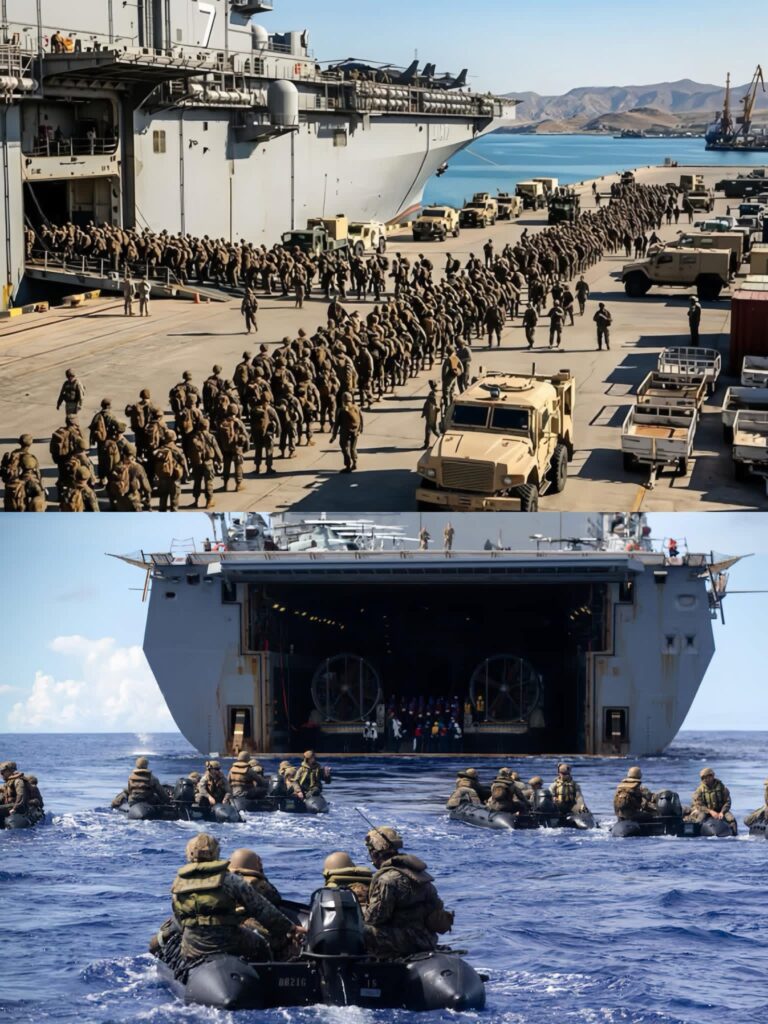
A Marine Expeditionary Unit (MEU) carrying roughly 2,200 U.S. Marines is being ordered to the Middle East, according to two U.S. officials familiar with the deployment. The force, embarked aboard three U.S. Navy amphibious ships, represents a rapid-response capability designed to handle a wide range of missions, from crisis response and evacuation operations to limited combat engagements.
The deployment comes at a time of heightened tensions across the region, where ongoing conflicts and geopolitical uncertainty have raised concerns about the safety of U.S. personnel and interests. While officials have not publicly detailed the specific mission of the unit, such movements typically signal a precautionary step aimed at increasing military readiness and flexibility.
A Marine Expeditionary Unit is a self-sustaining force that combines ground, air, and logistics elements under a single command. It usually includes an infantry battalion, a composite aviation squadron equipped with helicopters and tiltrotor aircraft, and a logistics combat element capable of sustaining operations for extended periods. This structure allows the MEU to operate independently or as part of a larger joint force.
The three amphibious ships carrying the Marines function as a mobile sea base. These vessels are capable of launching helicopters, landing craft, and amphibious assault vehicles, enabling troops to move quickly from sea to shore without relying on local infrastructure. This makes the MEU particularly valuable in volatile environments where access to ports or airfields may be limited or contested.
Defense officials say the decision to move the unit is part of a broader effort to ensure that the United States can respond swiftly to emerging threats. In recent months, the Middle East has seen a series of incidents involving regional militias, maritime security concerns, and strained diplomatic relations among key players. The presence of a ready Marine force provides commanders with options should the situation deteriorate.
Although no immediate combat operation has been announced, the MEU could be tasked with a variety of missions. These include protecting U.S. embassies, assisting in the evacuation of civilians, conducting humanitarian aid operations, or supporting allied forces. In more severe scenarios, the unit could also be used for targeted military strikes or to secure critical infrastructure.
Officials emphasized that such deployments are routine and are often used as a deterrent. By positioning forces closer to potential hotspots, the U.S. aims to signal its commitment to regional stability while maintaining the ability to act quickly if necessary.
The move also highlights the continued importance of naval power in modern military strategy. Amphibious ready groups, paired with Marine Expeditionary Units, allow the U.S. to project force without requiring permanent bases on land. This flexibility is particularly important in regions where political sensitivities or security risks limit long-term basing options.
As the situation in the Middle East continues to evolve, the presence of this Marine force is likely to be closely watched by both allies and adversaries. For now, officials say the deployment is about preparedness, ensuring that the U.S. is ready to respond to whatever challenges may arise.