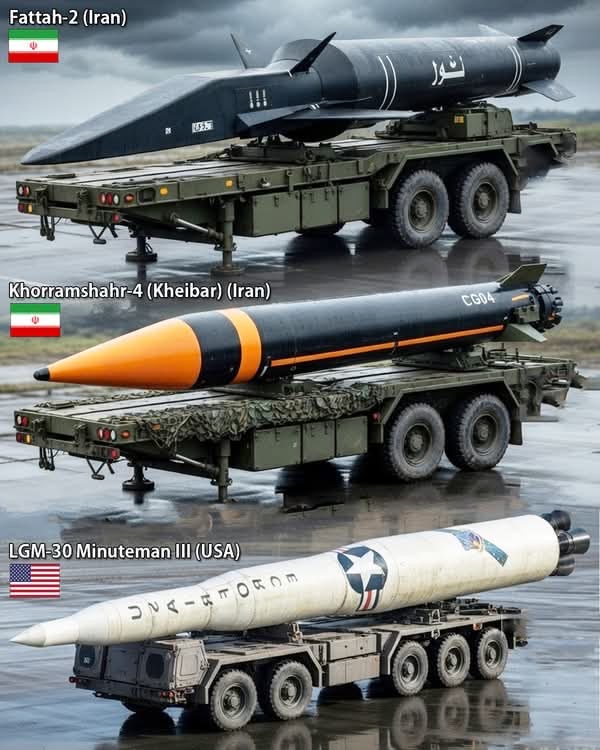
Modern missile technology reflects the strategic priorities and technological capabilities of different nations. Among notable systems are Iran’s Fattah-2 and Khorramshahr-4 (Kheibar), alongside the United States’ LGM-30 Minuteman III. Each represents a distinct approach to deterrence, range, and battlefield application.
The Fattah-2 is believed to be part of Iran’s newer generation of advanced missiles, reportedly incorporating hypersonic glide vehicle (HGV) technology. Hypersonic systems are designed to travel at extremely high speeds while maintaining maneuverability, making them difficult to detect and intercept. While detailed official specifications remain limited, the Fattah-2 reflects Iran’s effort to counter modern missile defense systems by focusing on speed, evasive flight paths, and precision targeting. This type of weapon emphasizes survivability against interception rather than sheer payload size or intercontinental range.
In contrast, the Khorramshahr-4, also known as the Kheibar, is a medium-range ballistic missile (MRBM) that prioritizes payload capacity and destructive power. Introduced in 2023, it has an estimated range of around 2,000 kilometers and can carry a warhead of approximately 1,500 kilograms. Unlike many missiles in its class, the Khorramshahr-4 focuses on delivering heavier payloads rather than extending its range. This allows it to target fortified infrastructure and strategic facilities across the Middle East. It is also designed with improved propulsion and reduced launch preparation time, increasing its operational readiness.
The Khorramshahr-4 may also incorporate maneuverable reentry vehicles and, according to some claims, the ability to carry multiple warheads. These features aim to complicate missile defense interception and enhance its effectiveness in regional conflicts. Its relatively short flight time and high speed further contribute to its strategic value as a regional strike weapon.
On the other hand, the LGM-30 Minuteman III represents a mature and highly reliable intercontinental ballistic missile (ICBM) system developed by the United States. First deployed in 1970, it remains a core component of the U.S. nuclear triad. With a range of approximately 14,000 kilometers, it far exceeds the reach of Iran’s Khorramshahr-4, enabling it to strike targets across continents.
The Minuteman III is equipped with advanced inertial guidance systems and can carry multiple independently targetable reentry vehicles (MIRVs), allowing a single missile to strike several targets. Its maximum speed, reaching around Mach 23, and its hardened silo-based deployment make it a formidable deterrent. Over decades, the system has undergone continuous upgrades to improve accuracy, reliability, and survivability.
In summary, these three missile systems highlight different strategic doctrines. Iran’s Fattah-2 emphasizes next-generation hypersonic capabilities and evasion. The Khorramshahr-4 focuses on heavy payload delivery within regional ranges. Meanwhile, the LGM-30 Minuteman III demonstrates long-range nuclear deterrence with proven reliability. Together, they illustrate how missile development is shaped by geography, military objectives, and technological advancement.