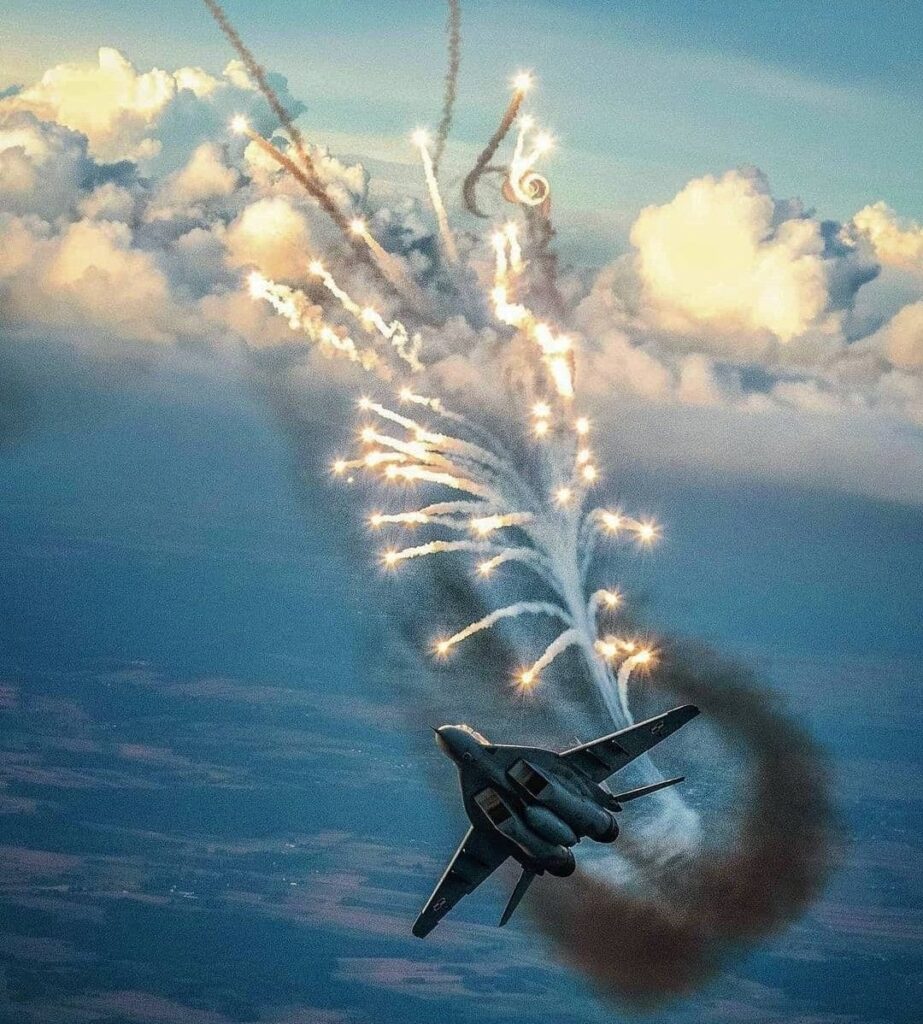
The Mikoyan MiG-29, known by its NATO reporting name “Fulcrum,” is a twin-engine, fourth-generation fighter aircraft originally developed in the Soviet Union. Designed by the Mikoyan design bureau during the 1970s, the MiG-29 was created to counter advanced Western fighters such as the F-15 Eagle and the F-16 Fighting Falcon. It entered service with the Soviet Air Forces in 1983 and quickly became one of the most recognizable combat aircraft of the late Cold War period.
The MiG-29 was designed primarily as an air superiority fighter. Its mission was to locate, intercept, and destroy enemy aircraft while protecting Soviet airspace and supporting ground forces. To achieve this goal, the aircraft combined powerful engines, advanced maneuverability, and a strong weapons system. The fighter is powered by two Klimov RD-33 engines, which allow it to reach speeds of about Mach 2.25, or roughly 1,500 miles per hour. The twin-engine configuration also improves survivability in combat, as the aircraft can sometimes continue flying if one engine fails.
One of the most notable features of the MiG-29 is its agility. The aircraft was designed with a wide wing root extension, which helps generate additional lift during sharp turns and high-angle maneuvers. This design allows the jet to perform extremely tight turns and maintain control during demanding aerial combat situations. Pilots have often praised the MiG-29 for its ability to compete with many Western fighters in close-range dogfights.
The MiG-29 is equipped with a combination of radar and infrared targeting systems that allow it to track and engage enemy aircraft. Its primary radar system enables pilots to detect targets at long range and guide missiles toward them. The aircraft also features a helmet-mounted sight system, which allows the pilot to aim missiles simply by looking at the target. This system works with short-range infrared missiles such as the R-73 missile, giving the MiG-29 a strong advantage in close combat situations.
In addition to missiles, the aircraft carries a built-in 30-millimeter GSh-30-1 cannon. This powerful cannon is effective against both aerial and ground targets. The MiG-29 can also carry a variety of bombs, rockets, and longer-range air-to-air missiles, allowing it to perform limited multirole missions beyond pure air combat.
Over time, the MiG-29 has been upgraded and improved through several variants. Modernized versions include better radar systems, improved avionics, and the ability to carry more advanced weapons. One example is the MiG-35, which incorporates modern sensors and enhanced combat capabilities while maintaining the core design of the original aircraft.
Today, the MiG-29 remains in service with numerous air forces around the world. Countries in Eastern Europe, Asia, the Middle East, and Africa continue to operate the aircraft in both original and upgraded forms. Its combination of speed, agility, and relatively low operating cost has helped it remain relevant decades after its introduction.
Although newer fighters have been developed, the MiG-29 Fulcrum still stands as one of the most iconic combat aircraft of the late 20th century. Its distinctive twin-engine design, powerful maneuverability, and combat reputation have secured its place in aviation history as one of the Soviet Union’s most important fighter jets.