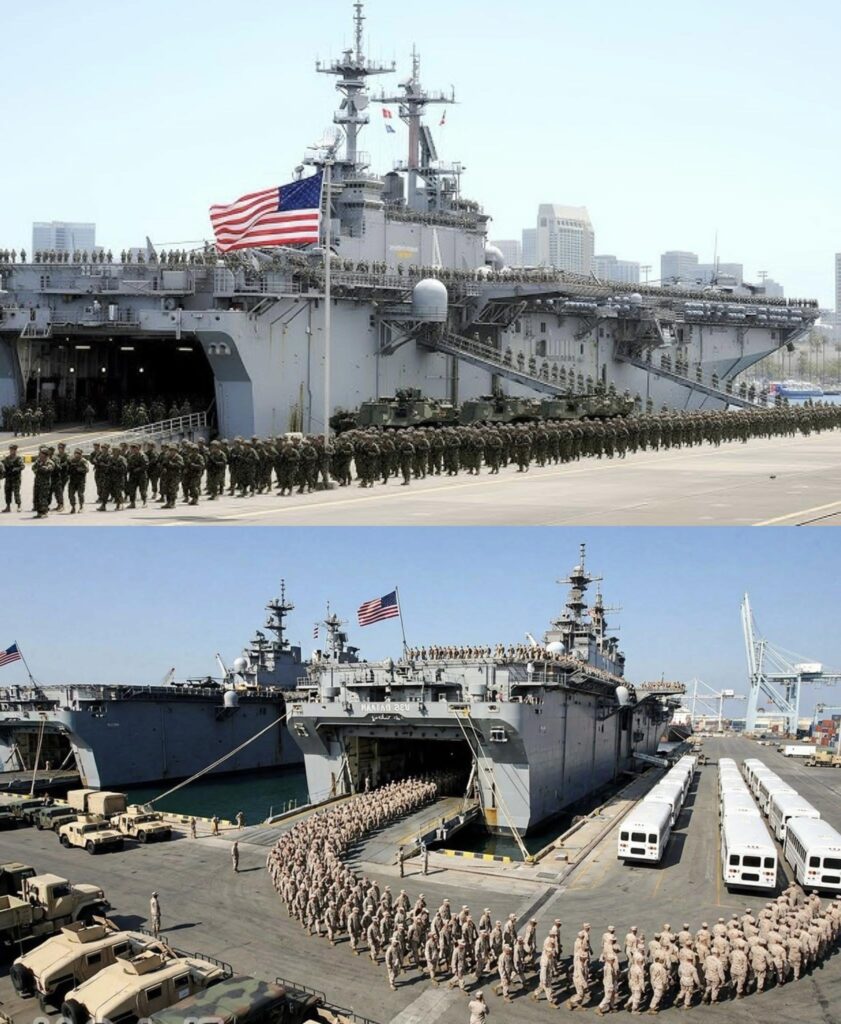
Three U.S. warships based in San Diego have departed with roughly 2,500 Marines from Marine Corps Base Camp Pendleton, heading toward the Middle East as tensions in the region continue to rise. The deployment highlights how quickly U.S. forces can move from the West Coast to areas of global concern when the situation demands it.
The ships reportedly left from Naval Base San Diego, the largest naval base on the U.S. West Coast and a key hub for amphibious operations. The deployment is being carried out by the United States Navy together with the United States Marine Corps, a combination designed for rapid response missions. Amphibious warships are specifically built to transport Marines, armored vehicles, aircraft, and supplies across long distances while remaining ready to launch operations immediately upon arrival.
According to defense officials, the 2,500 Marines involved are part of a Marine expeditionary force that trains constantly for crisis response, evacuation operations, and combat support missions. These Marines are based primarily at Camp Pendleton, one of the most important Marine training and deployment centers in the United States. From there, units can quickly load equipment, board ships, and deploy anywhere in the world, often within days.
The three warships involved are likely amphibious assault and transport vessels, which typically operate together as a small strike group. Each ship plays a specific role. One usually serves as the command center and flight deck for helicopters and advanced aircraft, while the others carry landing craft, armored vehicles, and large numbers of troops. Together, they form a flexible force capable of responding to a wide range of scenarios, from humanitarian missions to high-intensity combat operations.
The move comes at a time when the Middle East remains one of the most strategically sensitive regions in the world. Rising tensions in several countries have led the United States to reinforce its presence there as a precaution. Deployments like this are often intended to provide reassurance to allies, discourage potential aggression, and ensure that U.S. forces are ready if the situation worsens.
Military analysts say the speed of the deployment shows how central San Diego and Camp Pendleton remain to U.S. power projection. With warships constantly rotating through Naval Base San Diego and thousands of Marines stationed only a short distance away, the U.S. military can mobilize a significant force with very little warning. That ability is considered one of the key strengths of American expeditionary strategy.
For the Marines on board, the journey to the Middle East will take several weeks. During that time, they will continue training at sea, practicing amphibious landings, aircraft operations, and coordination between ships. By the time they arrive, they are expected to be fully prepared for any mission assigned to them.
This deployment reflects a familiar pattern in modern military operations: when tensions rise overseas, the first response often comes from the West Coast. And once again, warships leaving San Diego with Marines from Camp Pendleton show how quickly the United States can shift from routine training to real-world readiness.