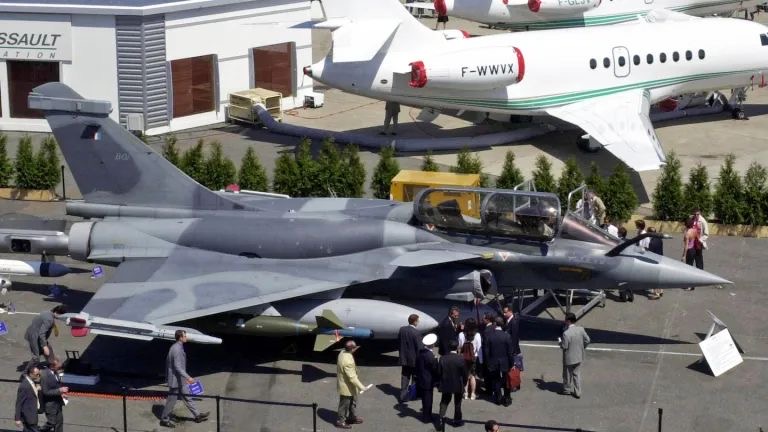
More Than Two Decades After They Were First Trialled, a Rafale Has Reappeared With Range- and Payload-Enhancing Conformal Fuel Tanks
More than twenty years after their initial trials, the Dassault Rafale has resurfaced equipped with conformal fuel tanks (CFTs), marking a significant step in the evolution of one of Europe’s most capable multirole fighters. The reintroduction of CFTs reflects Dassault Aviation’s continued effort to extend the Rafale’s endurance and versatility without compromising its aerodynamic performance. This development signals not only a renewed focus on long-range missions but also a response to modern operational demands that prioritize persistence, payload flexibility, and reduced reliance on external fuel tanks.
Conformal fuel tanks are designed to fit closely along the aircraft’s upper fuselage, blending seamlessly into its aerodynamic shape. Unlike traditional drop tanks, which hang from pylons and increase drag, CFTs maintain the aircraft’s clean lines while adding substantial fuel capacity. For the Rafale, this means extended range and mission duration—crucial advantages for both air superiority and deep-strike operations. Each tank is estimated to add roughly 1,150 liters of fuel, significantly increasing total endurance without taking up valuable underwing hardpoints that could otherwise carry weapons or reconnaissance pods.
When Dassault first experimented with conformal tanks in the early 2000s, the technology was still relatively new for European fighters. At that time, the concept did not progress beyond limited testing, largely due to weight trade-offs, integration challenges, and a lack of immediate customer demand. However, as operational theaters have expanded and missions have grown more complex, range and persistence have become top priorities. Modern air forces now expect their fighters to operate over greater distances and remain on station longer, often without the luxury of nearby tanker support.
The reappearance of a Rafale equipped with CFTs suggests Dassault has refined the design considerably. Advances in materials, modeling, and aerodynamic testing likely reduced the weight penalties that plagued earlier prototypes. The tanks now appear to fit more naturally into the aircraft’s spine, maintaining the Rafale’s low radar cross-section and handling balance. For export customers—such as those operating in regions where long-range patrols are essential—these upgrades make the Rafale an even more compelling option.
Strategically, the timing is notable. Dassault has been delivering Rafales to several international clients, including Egypt, India, Greece, and Indonesia. Many of these operators face vast maritime or desert environments where endurance and combat radius are vital. The integration of conformal tanks could help these air forces extend patrols, reduce aerial refueling needs, and carry heavier ordnance loads on missions that once required fuel compromises. For example, a Rafale configured with CFTs could carry its full complement of air-to-ground or anti-ship weapons while still maintaining sufficient fuel for extended engagement windows.
From a tactical standpoint, the improvement goes beyond range. With CFTs installed, the Rafale can retain a clean wing configuration, enhancing maneuverability and reducing radar drag. This helps preserve the aircraft’s agility and survivability in contested airspace. The tanks can also be removed when not needed, giving operators flexibility to tailor the aircraft to specific mission profiles.
In essence, the return of conformal fuel tanks to the Rafale platform marks the revival of a promising concept matured by time and technology. It underscores Dassault Aviation’s ongoing commitment to evolving its flagship fighter in step with modern operational realities. Two decades after their first appearance, the CFTs have finally found their place—not as an experiment, but as a key feature in extending the Rafale’s reach and effectiveness in a demanding global defense environment.