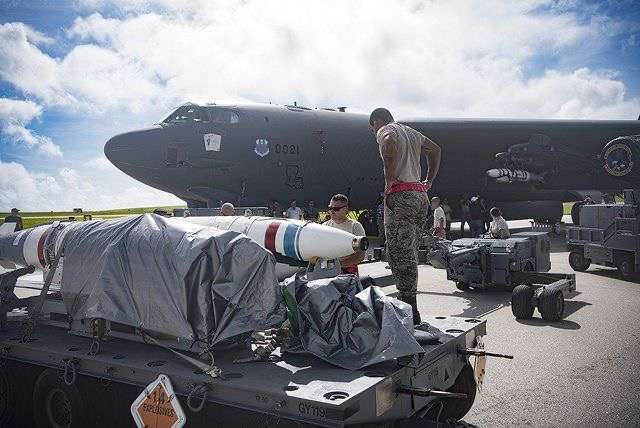
The B-52 has been around long enough to earn a reputation as a Cold War relic, but it keeps finding new ways to stay relevant. One of the most recent upgrades pushes the bomber into a different kind of mission: long-range precision mine-laying. Instead of flying directly over a target area and dropping mines the old-fashioned way, the aircraft can now release them from roughly 40 miles out. That distance might not sound extreme at first glance, but in the world of maritime operations it’s a major shift.
Traditional mine-laying forces aircraft to fly low and slow over water, right into the reach of surface-to-air missiles, radar networks, and enemy patrols. Extending the release point gives crews a cushion. It keeps the aircraft in safer airspace while still allowing mines to land in tight patterns where planners want them. The trick that makes this possible is the Quickstrike-ER, a guided mine based on a standard bomb body but fitted with GPS-aided glide kits. Instead of falling straight down, these mines travel forward, almost like small wings guiding themselves toward a programmed point on the water.
A bomber carrying dozens of these can shape an entire minefield in a single pass. That’s valuable in any conflict where sea lanes matter. Mines can slow fleets, block access to key straits, or protect friendly forces from naval incursions. A field that once required multiple aircraft and risky flights can now be laid with far less exposure. It gives planners a tool that’s both cheaper and more flexible than large surface ships performing the same job.
And this capability is only one part of a larger transformation. The Air Force is re-engining the B-52, updating its sensors, and giving it new weapons options. All of this pushes the aircraft closer to the role of a long-range launch platform rather than just a heavy bomber. Think of it as a truck that hauls smart weapons across continents, able to operate without refueling as often and to survive in more complex threat environments with better situational awareness.
The mine-laying upgrade shows what that future might look like. If a bomber can scatter a precision minefield without getting close to naval defenses, it suggests similar standoff tactics for other missions. The same gliding kits and GPS guidance used on mines can work on different payloads. Some could be used to target ships directly, while others might shape the battlespace before allied fleets arrive. The emphasis is shifting toward stand-off delivery, flexibility, and turning older platforms into carriers for modern smart systems.
It also signals something broader. Naval competition is growing in several regions, and the ability to influence the ocean without deploying large numbers of ships gives commanders new options. A few aircraft on short notice can do work that would otherwise demand a task force.
So while the image of a B-52 dropping mines may sound like a throwback to an earlier era, the reality is the opposite. The bomber is stepping into a modern role, one defined by precision, distance, and adaptability. The 40-mile minefield is impressive on its own, but it’s really a preview of the missions the aircraft is being shaped to handle next.