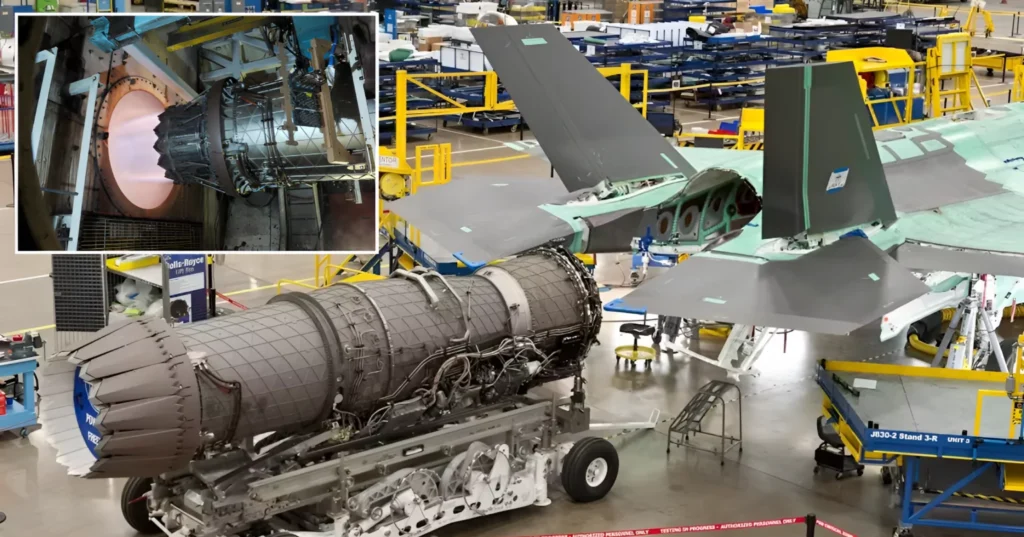
Despite its groundbreaking design, the F135 engine has faced a set of challenges that have become more visible as the F-35 program has matured. The engine was built to deliver exceptional thrust, reliability, and adaptability across three distinct variants of the aircraft. In many respects it has done exactly that. But as the F-35 has taken on a wider mission set and flown far more hours than originally projected, the strain on the engine’s thermal and mechanical systems has grown. This has pushed the F135 closer to its performance ceiling than planned, prompting renewed attention on cooling, thermal control, and long-term support costs.
One of the clearest pressure points is thermal management. Modern sensors, mission computers, and electronic warfare equipment generate substantial heat, and the F-35 integrates these systems in ways earlier fighters did not. The burden of handling that heat falls heavily on the engine. When the aircraft operates in high-demand scenarios, the F135 must remove heat from the airframe while also powering the jet. Over time, this has created cases where the temperature load exceeds what the original design comfortably manages. Sustained operation under these conditions can accelerate wear on components, raising the risk of early maintenance demands and reducing the engine’s margin for growth.
Cooling efficiency ties directly into this issue. The current setup can manage today’s missions, but future upgrades planned for the F-35’s avionics and weapons are expected to require even more cooling capacity. Without improvements, the engine would have to work harder to keep temperatures stable, which in turn affects durability. Engineers have been exploring updated materials, improved airflow paths, and revised component designs to increase the engine’s resilience under higher thermal loads.
Another area drawing attention is sustainment cost. The F-35 program is one of the largest aviation efforts ever undertaken, and engine maintenance represents a significant share of its lifecycle budget. When components wear faster due to temperature strain or heavier workloads, maintenance intervals shrink and costs rise. This has led to a push for upgrades that improve durability and reduce the frequency of depot-level repair. Better thermal control alone can make a noticeable difference, because cooler, more stable operation often translates to longer component life.
The calls for improvement do not reflect a failure of the original F135 design. Instead, they highlight how quickly operational expectations have evolved. The aircraft is flying more often, in tougher conditions, and with more sophisticated electronics than the engine was initially sized to support. The demands of modern combat aviation rarely stay static, and even high-performance systems need periodic redesign to keep pace.
As a result, discussions around engine enhancement programs have gained momentum. These efforts focus on making the F135 more robust, more efficient, and more affordable to operate over the decades ahead. The goal is not only to address current challenges but also to give the F-35 the growth capacity it needs for future missions. In that sense, the push for upgrades is part of the natural progression of a long-service engine supporting a rapidly advancing aircraft.