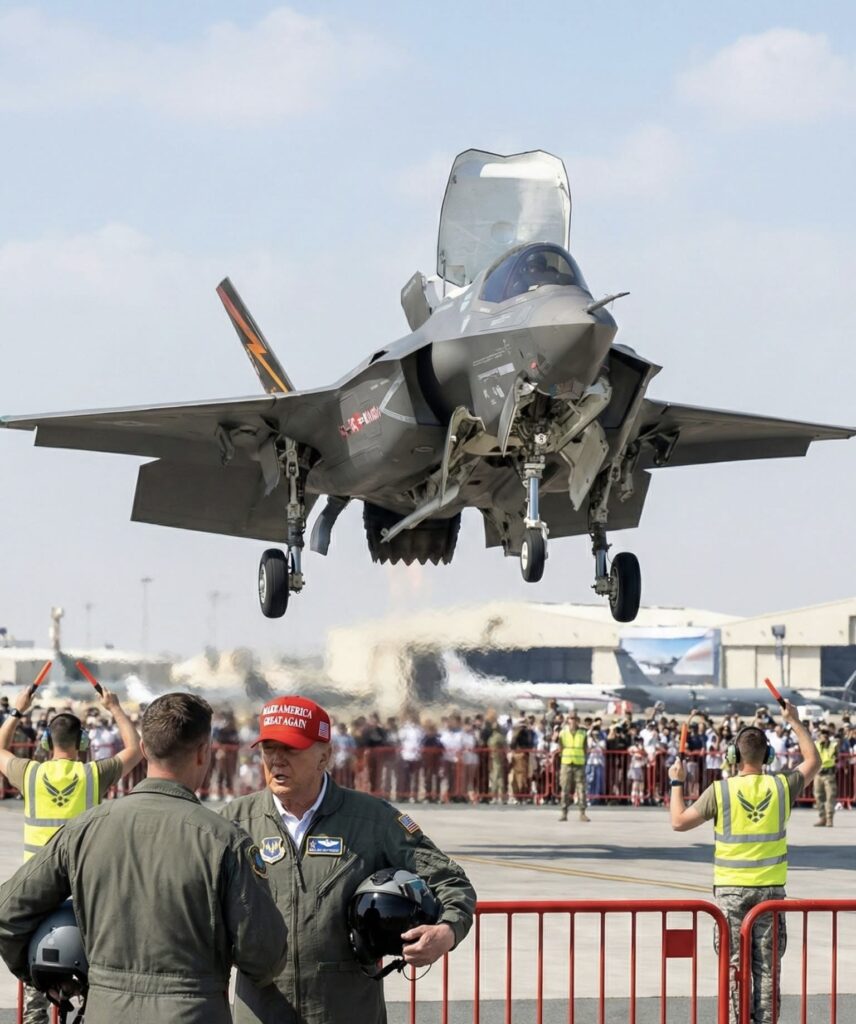
The F-35 has become a familiar sight at major aviation events, but its vertical landing demonstration at the Dubai Airshow always draws a special kind of attention. Crowds gather early, long before the jet appears in the distance, because everyone knows they’re about to watch something that feels both futuristic and surprisingly graceful. For a fighter built around power, stealth, and complex systems, its ability to hover and drop onto a runway with such precision continues to impress even seasoned aviation fans.
As the jet approaches show center, the noise begins to rise. The pilot lines up for a slow pass before transitioning into the short-takeoff-and-vertical-landing mode. It’s a moment that reveals the engineering behind the aircraft. Panels shift, doors open, and the lift fan engages. The aircraft’s pace drops until it’s hanging in the air, seemingly suspended over the runway. In Dubai’s warm, shimmering air, the effect looks almost surreal.
The crowd often falls quiet during these moments. Watching a fifth-generation fighter stop in midair feels different from a high-speed pass or a tight turn. Instead of showing raw speed or aggressive maneuvers, the F-35 shows control. Its downward-facing exhaust and the airflow from the lift fan work together to hold the aircraft in place while the pilot makes fine adjustments to maintain stability. Despite the enormous power involved, the jet settles downward with a steady, deliberate motion.
Once the aircraft touches down, you can sense the appreciation from the audience. People know they’ve just seen something that only a small number of jets in the world can do. The vertical landing isn’t just a performance trick. It demonstrates capabilities that allow the F-35B variant to operate from ships, forward bases, and locations that can’t support conventional runways. That flexibility is one of the reasons it draws so much attention at events like the Dubai Airshow, where defense officials, pilots, and aviation enthusiasts gather from around the world.
The demonstration also highlights the sophistication of the aircraft’s systems. Managing the transitions between conventional flight and hover requires constant coordination between engines, sensors, and flight controls. The pilot relies heavily on automated support, but the skill involved in handling the aircraft during a public display shouldn’t be underestimated. Every movement of the jet must be precise, especially when hovering close to the ground in front of a large crowd.
Dubai’s setting adds to the spectacle. The backdrop of modern architecture, desert light, and the large airshow ramp creates a stage that makes the F-35’s landing feel even more dramatic. Cameras click in rapid bursts as the jet touches down, and soon after, it taxis past the audience, canopy gleaming under the sun. It’s a moment that tends to be replayed across social media and news outlets because it captures what people find compelling about modern aviation: the blend of technology, performance, and real-world capability.
The F-35’s vertical landing at the Dubai Airshow is more than a highlight of the program. It’s a reminder of how far aircraft design has come and how much thought goes into producing a fighter that can take off and land in ways that once belonged only to prototypes or science fiction.