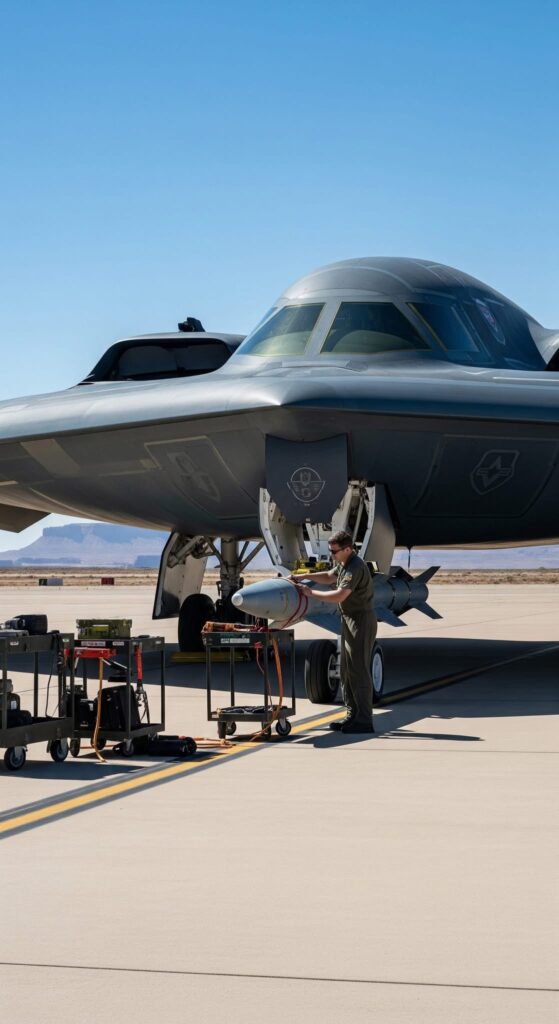
The B-21 Raider and the B-2 Spirit represent two generations of American stealth bomber design. Both aircraft are built to penetrate heavily defended airspace and deliver strategic strikes, but they reflect different eras, priorities, and technologies. Comparing them shows how advances in engineering, warfare, and cost control have shaped the future of long range air power.
The B-2 Spirit first entered service in the late 1990s and was revolutionary for its time. Its flying wing design, radar absorbing materials, and low observable shaping made it extremely difficult to detect. The B-2 was designed during the Cold War to penetrate Soviet air defenses and deliver nuclear weapons, though it later proved effective in conventional missions in Kosovo, Iraq, and Afghanistan. Even today, it remains one of the most survivable aircraft ever built. However, the B-2 came with major drawbacks. It was extraordinarily expensive to produce and maintain, with only 21 aircraft built. Maintenance requirements are intensive, especially for its stealth coatings, and mission readiness demands significant logistical support.
The B-21 Raider is intended to build on the B-2’s strengths while addressing its weaknesses. Developed decades later, the B-21 benefits from advances in digital design, materials science, and computing. While it retains a flying wing shape, it is smaller and optimized for adaptability. The Air Force designed the B-21 from the start to be more affordable to build and operate. Cost control was a core requirement, not an afterthought. This approach allows the Air Force to plan for a much larger fleet, which increases flexibility and resilience in a conflict.
Stealth is central to both aircraft, but the B-21 is expected to have a significant edge. Modern air defense systems rely on a mix of radar frequencies, passive sensors, and networked detection. The B-21 is designed to operate in this environment, with improved broadband stealth and the ability to update its systems through software rather than major hardware changes. This makes it more future proof than the B-2, whose upgrades are complex and costly.
In terms of mission roles, both bombers can carry nuclear and conventional weapons, but the B-21 is designed to integrate more easily with unmanned systems, space assets, and cyber capabilities. It is expected to act as part of a larger combat network rather than operating mainly as a standalone platform. The B-2, while highly capable, was designed in an era when such integration was limited.
Range and payload for both aircraft are impressive, but the B-2 has a larger payload capacity. The B-21 trades some of that capacity for efficiency, survivability, and flexibility. In modern warfare, the ability to survive and persist may matter more than carrying the maximum number of weapons on a single sortie.
In summary, the B-2 Spirit is a landmark aircraft that changed how the world viewed strategic bombing and stealth. The B-21 Raider is its evolution, shaped by modern threats and practical realities. While the B-2 remains formidable, the B-21 represents the future of stealth bombing, combining advanced technology with affordability and adaptability to meet the demands of decades to come.