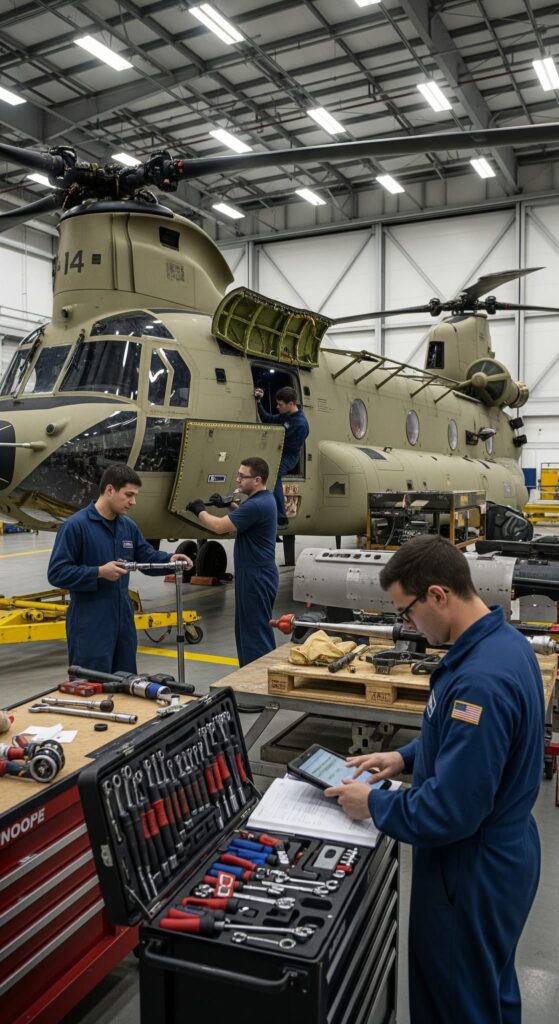
The CH-47 Chinook is one of the most recognizable and enduring military helicopters in the world. First introduced in the early 1960s, it was designed to meet the demanding needs of heavy lift operations. With its distinctive twin rotor configuration, the Chinook has proven its value across decades of service, multiple conflicts, and a wide range of missions. Although the title is often misspelled, the aircraft is correctly known as the CH-47 Chinook.
What sets the Chinook apart is its tandem rotor design. Instead of a single main rotor and tail rotor, it uses two large rotors mounted fore and aft. This configuration provides excellent lift capability and stability, allowing the aircraft to carry heavy loads while remaining relatively compact in length. The absence of a tail rotor also means more engine power is devoted to lift rather than counteracting torque, which contributes to its impressive performance.
The CH-47 was originally developed by Boeing Vertol for the United States Army, and it quickly became a backbone of military logistics. It can transport troops, vehicles, artillery, and supplies over long distances and difficult terrain. Inside the cargo bay, the Chinook can carry more than 30 fully equipped soldiers or large equipment such as light armored vehicles. Externally, it can lift heavy loads using a sling system, making it invaluable in situations where landing is not possible.
Over the years, the Chinook has seen extensive use in combat, humanitarian, and disaster relief missions. In wartime, it has been used to move troops rapidly, resupply forward operating bases, and evacuate casualties. In peacetime, it often supports disaster response by delivering food, water, and medical aid to areas cut off by floods, earthquakes, or landslides. Its ability to operate in harsh environments, including high altitudes and extreme heat, has made it especially useful in regions such as Afghanistan.
The aircraft has undergone numerous upgrades to keep it relevant. Modern variants feature advanced avionics, improved engines, and enhanced survivability systems. These updates have extended the Chinook’s service life and ensured compatibility with modern military requirements. Despite its age, the platform continues to evolve rather than being replaced outright, which speaks to the strength of its original design.
Today, the CH-47 Chinook is operated by many countries around the world, including the United States, the United Kingdom, Australia, and several NATO allies. Its continued global use highlights its reliability and adaptability. More than sixty years after its first flight, the Chinook remains a symbol of heavy lift aviation and a clear example of how thoughtful engineering can stand the test of time.