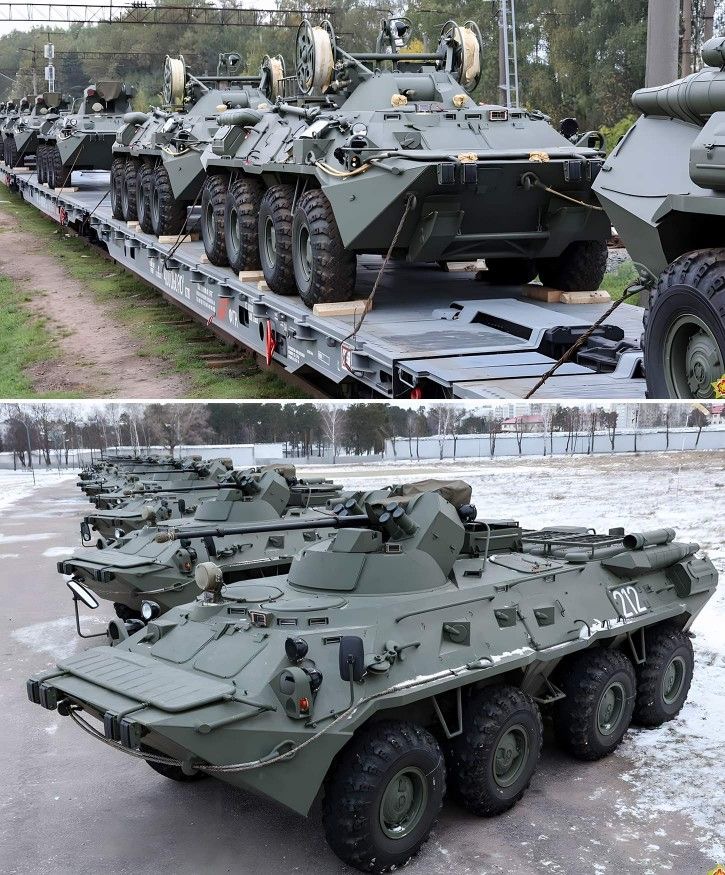
The BTR-82 signal and command variant represents a specialized evolution of Russia’s widely used BTR family of wheeled armored personnel carriers. While the standard BTR-82A is designed to transport infantry and provide direct fire support, the signal and command version focuses on coordination, communication, and battlefield management. Its role is less about frontline firepower and more about ensuring units can operate effectively in complex and fast-moving combat environments.
At its core, the BTR-82 signal and command variant serves as a mobile headquarters. It is built to operate alongside mechanized and motor rifle units, maintaining constant communication with higher command, subordinate elements, and adjacent formations. This capability is critical in modern warfare, where situational awareness and rapid decision making often determine the outcome of engagements. By staying armored and mobile, command staff can remain closer to the action without relying on static command posts that are vulnerable to attack.
Externally, this variant closely resembles the standard BTR-82, which helps it blend in with other vehicles in a formation. It retains the 8×8 wheeled configuration, amphibious capability, and diesel engine that give the platform strong mobility across roads, rough terrain, and water obstacles. However, subtle differences such as additional antennas, modified roof fittings, and altered rear compartments signal its specialized mission. These changes are designed to support advanced radio systems rather than troop seating or heavy weaponry.
Inside the vehicle, the most significant differences become apparent. The troop compartment is reconfigured to accommodate communication equipment, workstations, and power systems. Operators can manage multiple radio networks simultaneously, including encrypted voice and data links. This allows commanders to issue orders, receive reports, and coordinate artillery, air support, or maneuver elements in real time. The vehicle’s electrical system is upgraded to handle the increased load from these systems, ensuring reliable operation even during extended missions.
Protection remains an important consideration. The BTR-82 signal and command variant benefits from improved armor compared to older BTR models, offering better resistance to small arms fire and shell fragments. Smoke grenade launchers are typically fitted to provide concealment if the vehicle comes under threat. While it is not intended to lead assaults, it is designed to survive in contested environments long enough to fulfill its command role.
In practical terms, this vehicle reflects a broader shift in military doctrine. Modern forces place increasing emphasis on networked operations, where information flows quickly and accurately across all levels of command. The BTR-82 signal and command variant is a physical embodiment of that approach, combining mobility, protection, and communication in a single platform. Rather than replacing traditional command structures, it enhances them by allowing leaders to move with their units and adapt to changing battlefield conditions.
Overall, the BTR-82 signal and command variant is a reminder that not all combat vehicles are defined by their weapons. Some are defined by their ability to connect people, systems, and decisions under pressure. In modern warfare, that capability can be just as decisive as firepower.