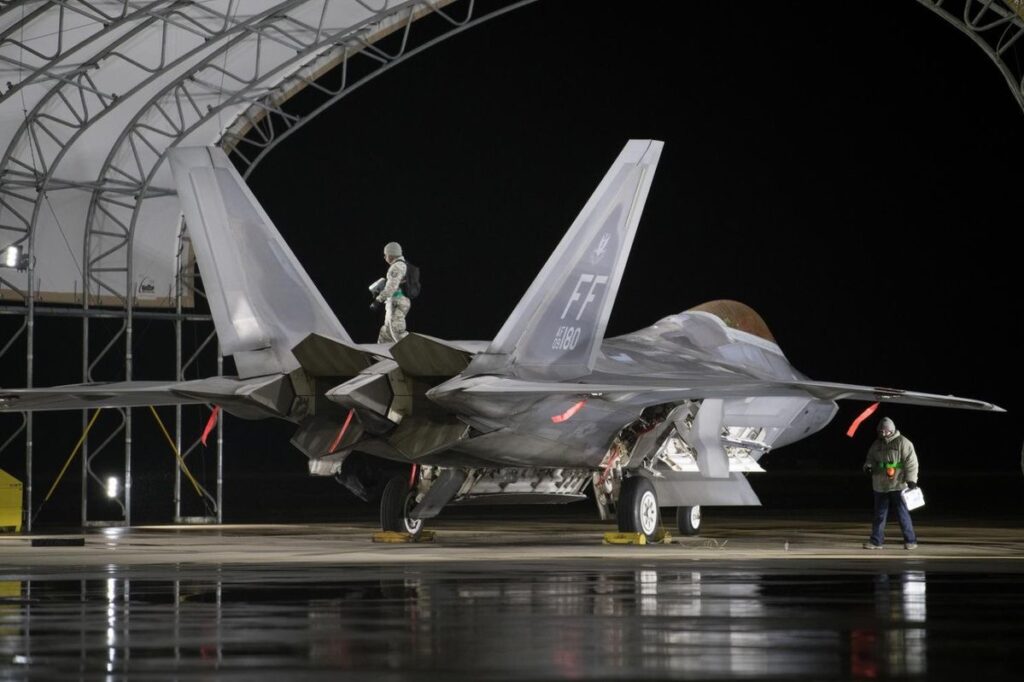
The F-22 Raptor is widely regarded as one of the most advanced fighter aircraft ever built. Developed for the United States Air Force, it was designed to dominate the skies in air-to-air combat while also carrying out precision ground attacks, electronic warfare, and intelligence missions. From its first flight in 1997 to its operational debut in the mid-2000s, the F-22 set a new benchmark for what a fifth-generation fighter could achieve.
At the heart of the Raptor’s capability is stealth. Its shape, materials, and internal weapons bays are engineered to minimize radar detection. Unlike older fighters that carry missiles and bombs on external pylons, the F-22 stores most of its weapons inside the fuselage. This reduces its radar signature and allows it to approach hostile airspace with a significantly lower chance of being tracked. Stealth is not simply about invisibility, but about gaining the first look, first shot, and first kill advantage in combat.
Powering the aircraft are two Pratt and Whitney F119 engines equipped with thrust-vectoring nozzles. These engines allow the F-22 to supercruise, meaning it can sustain supersonic speeds without using afterburners. Supercruise gives the Raptor greater fuel efficiency at high speeds and extends its combat range. The thrust-vectoring capability also enhances maneuverability, enabling tight turns and dramatic aerial movements that give it a decisive edge in dogfights.
The avionics suite is another defining feature. The F-22 integrates advanced sensors, radar, and electronic systems into a single, cohesive picture for the pilot. Its AN/APG-77 active electronically scanned array radar provides long-range detection while maintaining a low probability of intercept. Sensor fusion allows the pilot to process large amounts of battlefield information quickly, reducing workload and improving situational awareness. In many ways, the Raptor was among the first aircraft to turn the cockpit into a high-tech information hub rather than just a flight station.
In terms of armament, the F-22 carries AIM-120 AMRAAM and AIM-9 Sidewinder missiles for air-to-air engagements, along with a 20 mm M61A2 cannon for close combat. For ground attack missions, it can deploy precision-guided bombs while maintaining its stealth profile. This versatility makes it capable of handling a wide range of missions without sacrificing its primary air superiority role.
Despite its strengths, the F-22 program faced challenges. High development costs and shifting defense priorities led to the production line closing in 2011 after 187 operational aircraft were built. Even so, the Raptor remains a critical component of U.S. air power. Its combination of stealth, speed, agility, and sensor integration keeps it relevant against evolving threats.
Today, the F-22 continues to train, deploy, and adapt. While newer platforms such as the F-35 have entered service, the Raptor’s pure air dominance focus ensures it retains a unique place in modern aviation. More than two decades after its first flight, the F-22 Raptor still represents the cutting edge of fighter design and remains a symbol of technological superiority in the skies.