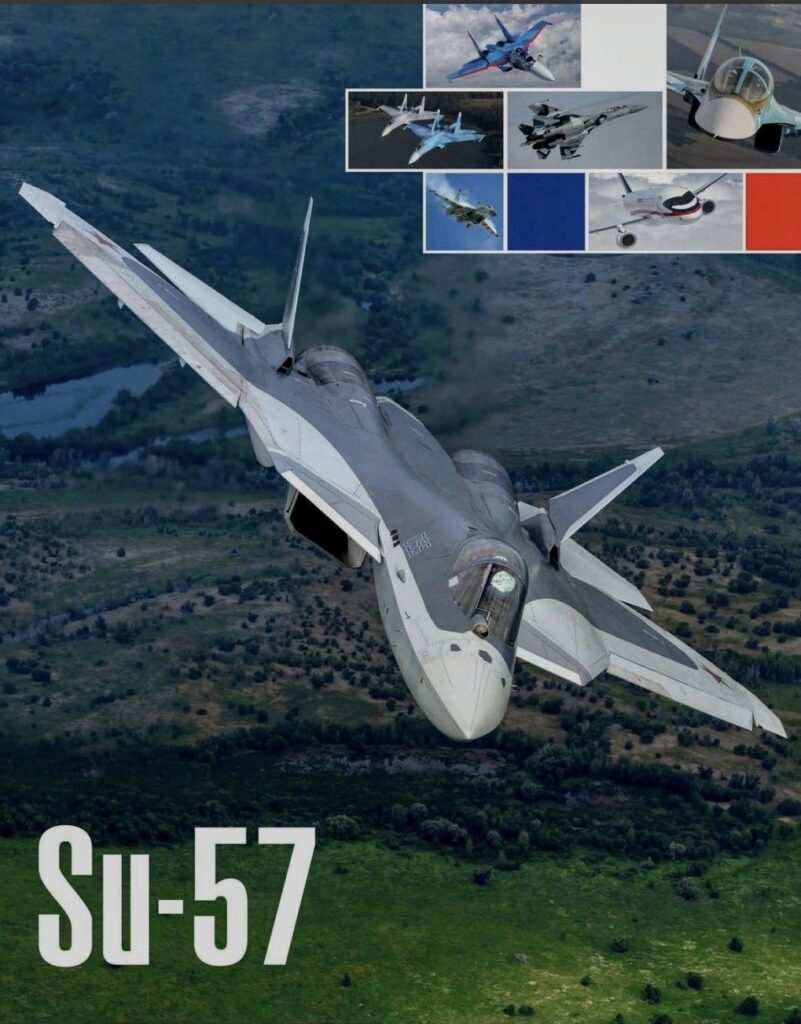
The Su-57 is Russia’s first operational fifth generation stealth fighter, developed to replace aging Soviet era aircraft and compete with modern Western platforms. Designed by Sukhoi under the United Aircraft Corporation, the aircraft reflects Moscow’s effort to restore its position in advanced combat aviation after the Cold War slowdown.
Development of the Su-57 began in the early 2000s under the PAK FA program, which stands for “Prospective Airborne Complex of Frontline Aviation.” The aircraft made its first flight in 2010. Early prototypes were known as the T-50, and the program moved through a long testing phase that included structural refinements, avionics upgrades, and engine development challenges. Serial production officially began in the early 2020s, with deliveries to the Russian Aerospace Forces following shortly after.
The Su-57 was built around stealth principles, but its design philosophy differs from some Western fighters. Instead of focusing solely on radar cross section reduction, Russian engineers aimed for a balance between stealth, speed, agility, and firepower. The aircraft features blended wing body shaping, internal weapons bays, radar absorbing materials, and serrated edges to reduce radar signature. However, analysts often debate how its stealth performance compares to that of aircraft such as the F-22 or F-35.
One of the defining features of the Su-57 is its maneuverability. It uses thrust vectoring engines that allow the aircraft to perform extreme aerial maneuvers at high angles of attack. This capability is consistent with Russia’s long standing emphasis on close range dogfighting and air dominance through agility. The fighter is expected to receive the newer “Izdeliye 30” engines, which promise greater thrust, improved fuel efficiency, and reduced infrared signature compared to the earlier powerplants.
Avionics are another core element of the Su-57’s design. The aircraft is equipped with an advanced active electronically scanned array radar system and distributed sensors that enhance situational awareness. Its cockpit includes large multifunction displays and is designed to support network centric warfare, allowing the aircraft to share data with other platforms. Russian officials have also highlighted artificial intelligence assisted systems intended to support pilot decision making.
In terms of armament, the Su-57 carries weapons internally to preserve stealth. It can deploy air to air missiles, precision guided bombs, and air to surface munitions. External hardpoints are available when stealth is less critical and maximum payload is required. The fighter is intended to perform a wide range of missions, including air superiority, ground attack, and electronic warfare support.
The Su-57 has also been marketed for export, although international sales have been limited. India initially partnered in a related program but later withdrew. Russia has since promoted the aircraft to other potential buyers while continuing to refine the platform domestically.
Overall, the Su-57 represents a significant step in Russia’s military aviation capabilities. While questions remain about production scale, cost, and real world performance, the aircraft stands as a symbol of Russia’s ambition to maintain technological parity in the evolving landscape of fifth generation air combat.