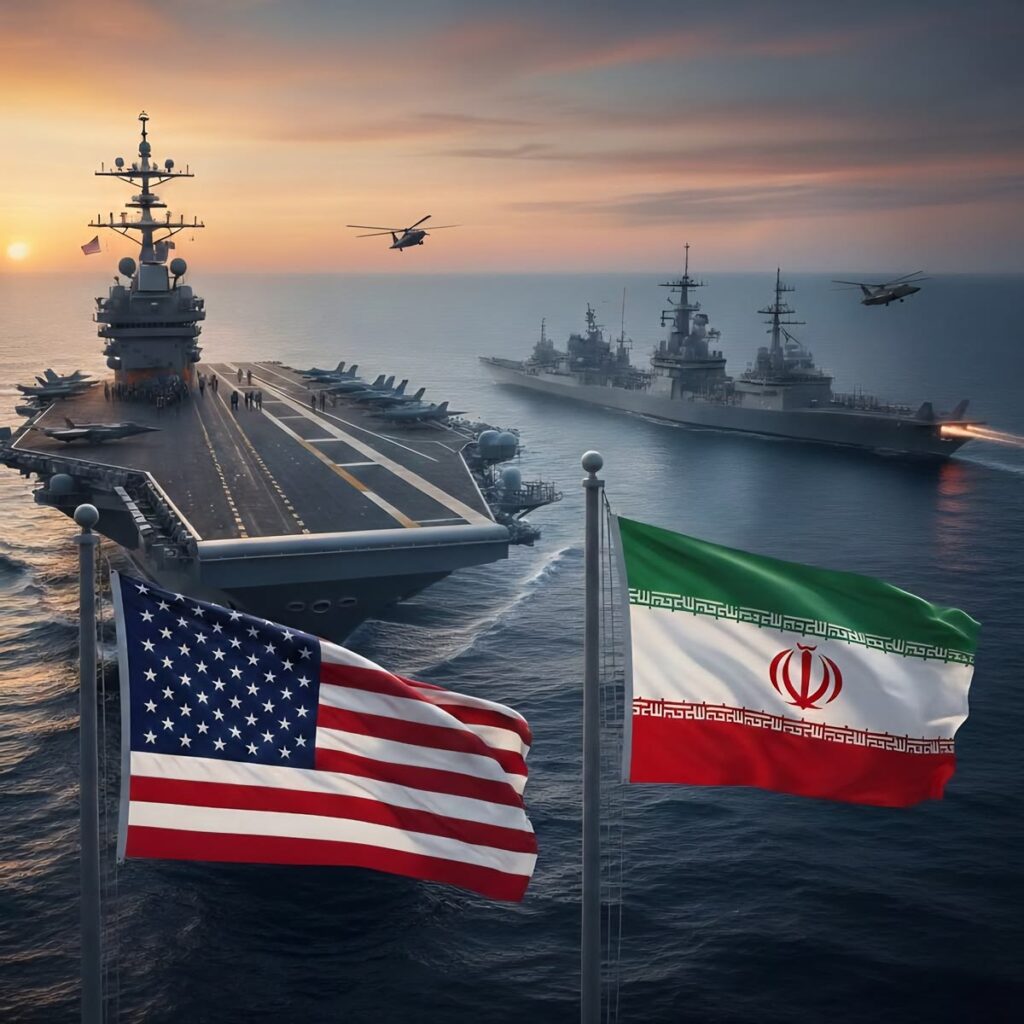
An aircraft carrier at sea is more than steel and machinery. It is a floating airbase, a strategic signal, and a visible extension of national policy. When a U.S. aircraft carrier sails with its escorting destroyers, cruisers, and support ships, it represents readiness and reach. Placed alongside the national flags of the United States and the Islamic Republic of Iran, that image carries layers of political and military meaning shaped by decades of tension, diplomacy, and cautious calculation.
A modern U.S. aircraft carrier is among the largest warships ever built. Its flight deck supports fighter jets, surveillance aircraft, and helicopters that can operate day or night. Beneath the deck are maintenance bays, fuel systems, command centers, and living quarters for thousands of sailors. Around it sail guided missile destroyers and cruisers equipped with advanced radar and missile defense systems, along with submarines that often remain unseen. Together, they form a carrier strike group designed for both deterrence and rapid response.
The flag of the United States, with its thirteen stripes and fifty stars, reflects a long maritime tradition. From the early days of the republic, naval power has played a central role in protecting trade routes and projecting influence abroad. The presence of a carrier in contested waters signals commitment to allies and a willingness to defend international navigation.
Across the water, the flag of the Islamic Republic of Iran carries its own symbolism. Its green, white, and red bands reflect cultural and religious heritage, while the emblem at the center represents the country’s identity since the 1979 revolution. Iran’s naval forces, though smaller in scale, are strategically focused on the Persian Gulf and the Strait of Hormuz. These waterways are vital corridors for global energy supplies. Iranian vessels often emphasize speed, maneuverability, and familiarity with local geography.
When these two flags appear in the same frame as naval vessels, the scene suggests both proximity and distance. Proximity, because the forces of each nation operate within reach of one another in narrow and heavily traveled seas. Distance, because their political narratives and security priorities remain far apart. Encounters at sea are typically governed by established communication protocols, yet they unfold against a backdrop of mistrust.
Such imagery can serve different purposes depending on context. It may underscore deterrence, reminding observers that military capabilities stand ready. It may also highlight the delicate balance required to prevent incidents from escalating. Naval commanders on both sides understand that a single miscalculation in crowded waters could carry serious consequences.
At the same time, the sea has long been a place where rivals observe one another without direct conflict. Ships pass, aircraft monitor, and messages are sent through posture rather than words. The presence of powerful vessels beneath national flags becomes a form of silent dialogue.
In the end, an aircraft carrier and its accompanying ships represent strength and preparedness. The flags represent sovereignty and identity. When viewed together, they capture a moment in an ongoing relationship defined by competition, caution, and the enduring importance of maritime power.