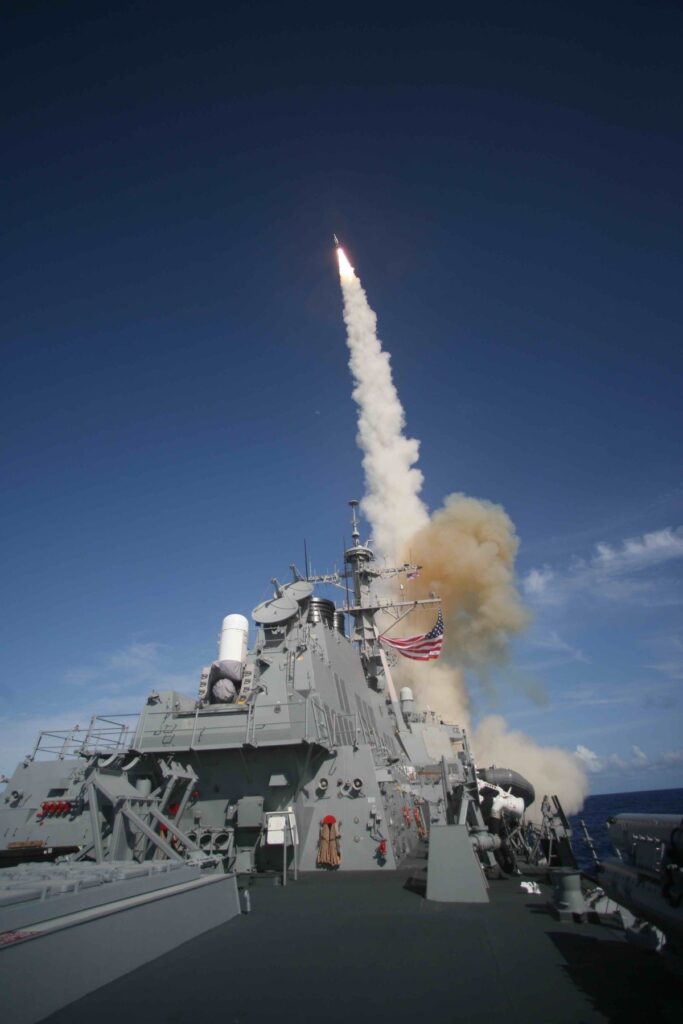
What’s happening in the image:
- A missile has just been fired from the ship’s vertical launch system (VLS). These launch cells are built into the deck and allow missiles to be fired straight up before they turn toward their target.
- The bright flame at the base of the missile is from its rocket motor igniting as it leaves the launch cell.
- The thick white smoke trail shows the rapid acceleration of the missile as it climbs into the sky.
- Around the launch point, you can see a large cloud of exhaust and smoke spreading across the ship’s deck area. This is normal during missile launches because the rocket motor produces extremely hot gases.
- The U.S. flag flying from the ship’s mast indicates it is a vessel of the United States Navy.
- The surrounding open ocean and clear blue sky suggest the launch is likely part of a training exercise or weapons test at sea.
Visible features on the ship:
- Radar and communication antennas mounted on the mast.
- Sensors and electronic systems used for targeting and tracking.
- Deck equipment and safety gear positioned along the sides of the ship.
- The VLS launch area integrated into the forward part of the vessel.
Why missiles are launched this way:
Vertical launch systems are widely used on modern warships because they allow a ship to quickly fire different types of missiles, including:
- Air defense missiles (to intercept aircraft or incoming missiles) ✈️
- Surface strike missiles (against ships or land targets) 🎯
- Anti-submarine rockets 🛥️
Launching vertically gives the missile 360-degree coverage, meaning it can turn toward any direction after leaving the ship.
If you want, I can also explain what type of missile this might be and how the vertical launch system on modern warships works. 🚢