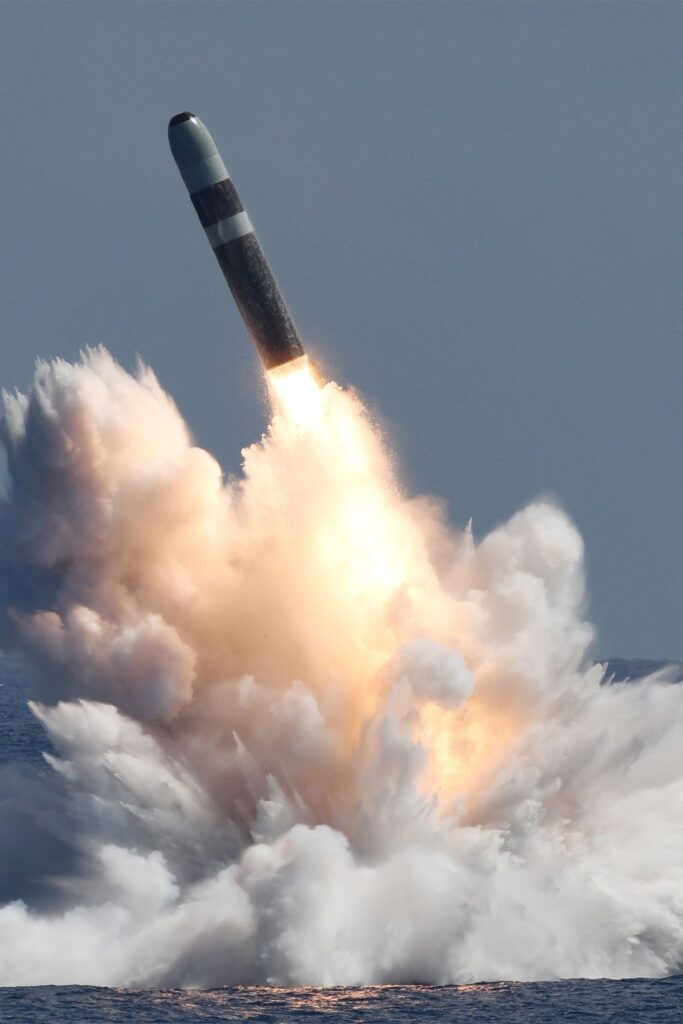
The Trident II D5 is one of the most advanced submarine-launched ballistic missiles (SLBMs) ever developed. Designed for long-range strategic deterrence, the missile is normally associated with nuclear warheads carried aboard ballistic missile submarines. However, in some testing, training, and verification missions, the missile is launched without nuclear warheads, often referred to as an unarmed Trident II D5. These launches are a critical part of maintaining the reliability, safety, and operational readiness of the system.
The Trident II D5 was developed by Lockheed Martin for the United States Navy and first entered service in 1990. It replaced the earlier Trident I C4 and remains the backbone of the U.S. sea-based nuclear deterrent. The missile is deployed aboard Ohio-class submarine vessels, which can remain hidden beneath the ocean for extended periods while carrying a powerful strategic payload.
When the Trident II D5 is launched in an unarmed configuration, it does not carry live nuclear warheads. Instead, the missile is typically fitted with instrumented test payloads or inert reentry vehicles. These payloads allow engineers and military specialists to collect detailed flight data. Sensors track the missile’s performance during every phase of its trajectory, including launch, stage separation, midcourse travel, and reentry. The data gathered helps confirm that the missile continues to perform according to design specifications.
One of the most common reasons for launching an unarmed Trident II D5 is the Demonstration and Shakedown Operation (DASO). During a DASO test, a ballistic missile submarine fires one or more missiles to prove that both the submarine and its crew are fully capable of conducting a strategic launch. These operations often take place after a submarine has undergone maintenance or modernization. By conducting an unarmed launch, the navy can validate the system without using nuclear warheads.
The missile itself is a three-stage, solid-fuel ballistic missile capable of traveling more than 7,000 kilometers (about 4,350 miles). It uses advanced guidance systems to maintain exceptional accuracy over intercontinental distances. Even in unarmed tests, the missile follows a realistic trajectory that mirrors the path it would take in an operational scenario. This ensures that all onboard systems, including navigation and propulsion, are properly evaluated.
Over the years, the Trident II D5 has built a reputation for reliability. The missile has achieved one of the highest success rates of any ballistic missile system ever fielded, with dozens of successful test launches conducted by the United States and its close ally, the United Kingdom, which also operates the system aboard Vanguard-class submarine vessels.
The continued testing of unarmed Trident II D5 missiles plays an important role in maintaining strategic stability. By verifying that the system remains dependable, these tests support the credibility of nuclear deterrence while avoiding the risks associated with live warheads. In essence, an unarmed Trident II D5 launch demonstrates readiness, reliability, and technological precision without deploying the destructive power the missile is ultimately designed to carry.
As long as submarine-based deterrence remains a key component of national defense strategies, unarmed test launches of the Trident II D5 will remain an essential part of keeping this complex system safe, effective, and operational.