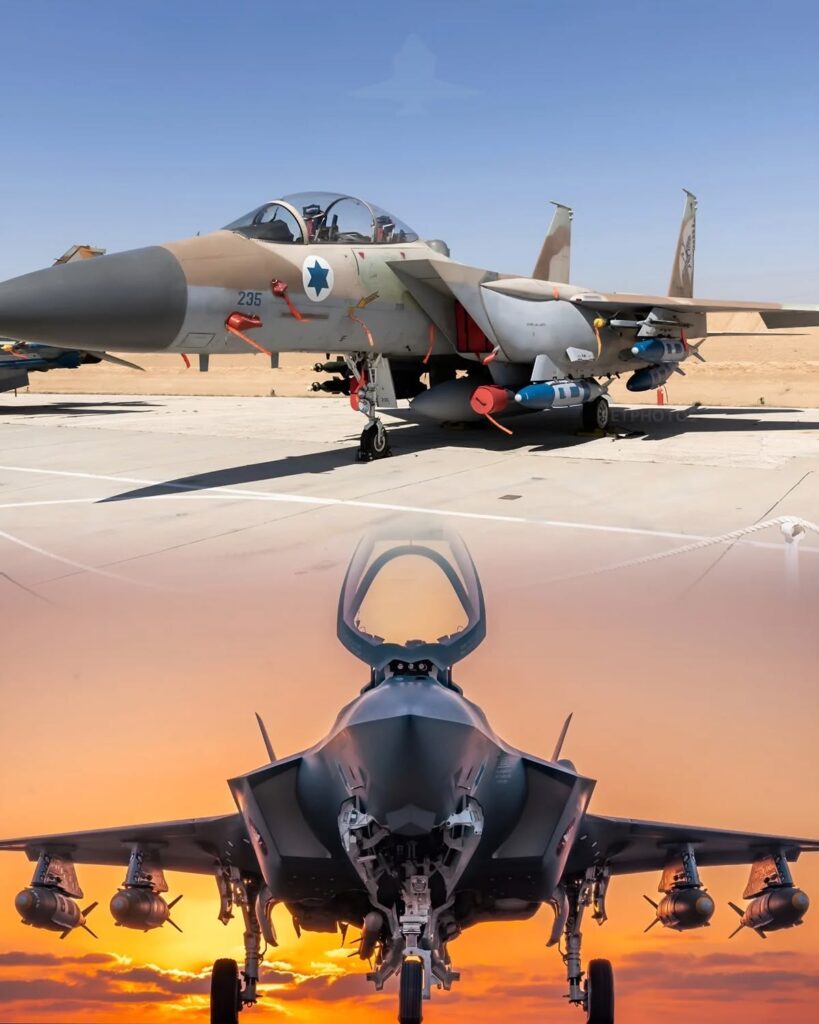
The modern air forces of many countries rely on advanced fighter aircraft to protect their airspace and maintain military strength. Two of the most well-known American fighter jets are the F-35 Lightning II and the F-15 Eagle. Although both aircraft serve the United States and allied forces, they were designed in different eras and for different missions. Comparing them shows how fighter aviation has evolved over time. ✈️
The F-15 Eagle was first introduced in the 1970s during the Cold War. Its primary purpose was air superiority, which means defeating enemy aircraft in aerial combat. Engineers designed the F-15 with powerful engines, excellent maneuverability, and advanced radar for its time. Because of its strong thrust-to-weight ratio, the jet can climb rapidly and reach speeds over Mach 2.5. This made it one of the fastest and most capable fighters in the world when it entered service.
One of the most impressive aspects of the F-15 is its combat record. The aircraft has achieved more than 100 aerial victories without a single loss in air-to-air combat. Over the years, newer versions such as the F-15E Strike Eagle added ground-attack capabilities. This allowed the aircraft to carry heavy bomb loads while still maintaining strong air combat performance. Even today, upgraded variants like the F-15EX continue to serve as powerful fighters due to their large payload capacity and reliability.
In contrast, the F-35 Lightning II represents a new generation of fighter aircraft. Developed decades later, it was designed with stealth technology, advanced sensors, and digital networking capabilities. Unlike older fighters that relied mainly on speed and maneuverability, the F-35 focuses on information dominance. Its stealth shape and special coatings reduce radar detection, allowing it to approach enemy defenses more safely.
Another important feature of the F-35 is its sensor fusion system. The aircraft collects data from multiple sensors, including radar, infrared cameras, and electronic systems, and combines them into a single clear picture for the pilot. This technology greatly improves situational awareness. Pilots can see threats, friendly aircraft, and targets in real time through their helmet-mounted display. 🛰️
The F-35 is also designed as a multirole fighter, meaning it can perform many types of missions. These include air-to-air combat, ground attack, intelligence gathering, and electronic warfare. There are three main variants of the aircraft: the F-35A for conventional runways, the F-35B capable of short takeoff and vertical landing, and the F-35C designed for aircraft carrier operations. This flexibility allows different military branches to use the same aircraft platform.
Despite its advanced technology, the F-35 does not completely replace aircraft like the F-15. Instead, the two fighters can complement each other. The F-35 can operate stealthily to detect threats and gather information, while the F-15 can carry large numbers of missiles and weapons. Working together, they create a stronger and more effective air combat system.
In conclusion, the F-15 Eagle and the F-35 Lightning II represent two important stages in the evolution of military aviation. The F-15 demonstrates the power of speed, maneuverability, and proven combat performance, while the F-35 highlights modern technology such as stealth, data integration, and multirole capability. Together, they show how fighter aircraft continue to adapt to new challenges in modern warfare. 🌍✈️