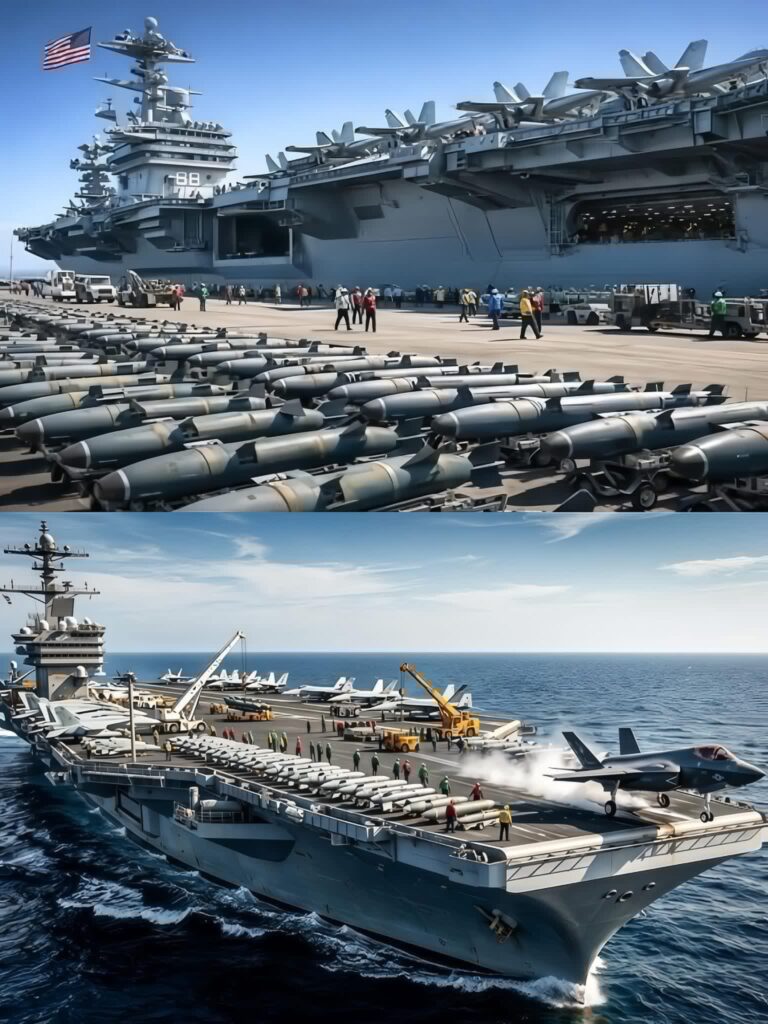
Tensions in the Middle East have reached a boiling point as the United States dramatically increases its naval presence near Iran. At the center of the buildup is the aircraft carrier USS Nimitz, one of the most powerful warships ever built. Reports and military movements suggest that the carrier strike group has been preparing for potential combat operations, with large numbers of missiles and munitions loaded aboard its escort ships and aircraft.
The deployment comes as the region faces growing instability following clashes involving Iran, Israel, and U.S. forces. According to defense reports, the carrier was redirected from the Indo-Pacific toward the Middle East as tensions escalated. The move is widely viewed as a signal that Washington is prepared to respond quickly if the situation deteriorates further.
An aircraft carrier like the Nimitz is more than just a ship. It serves as the centerpiece of an entire strike group made up of guided-missile destroyers, cruisers, submarines, and dozens of advanced fighter jets. These ships carry powerful cruise missiles, including variants such as the Tomahawk missile, which can strike targets hundreds of miles away with high precision.
When a carrier strike group prepares for possible conflict, hundreds of weapons may be loaded onto the ships and aircraft that accompany the carrier. This includes air-to-surface missiles for fighter jets, long-range cruise missiles on destroyers, and defensive interceptors designed to shoot down incoming threats. Such preparations allow the fleet to conduct sustained operations against land, sea, or air targets.
The show of force also sends a powerful strategic message. Military analysts often describe aircraft carriers as floating airbases capable of projecting power anywhere in the world. By positioning a carrier strike group close to a potential flashpoint, the United States demonstrates its ability to launch airstrikes, defend allies, and control key maritime routes.
In the case of Iran, the presence of the Nimitz is especially significant because of the importance of the Persian Gulf and the Strait of Hormuz, through which a large portion of the world’s oil supply passes. Any disruption in this area could have major global economic consequences. The United States has long maintained naval forces in the region to ensure freedom of navigation and deter attacks on shipping.
Recent reports also indicate that U.S. forces have expanded operations targeting Iran’s naval capabilities, striking vessels, drone facilities, and other infrastructure used to threaten regional waterways. These actions highlight the growing confrontation between the two countries as both sides attempt to demonstrate strength without triggering a full-scale war.
For Iran, the arrival of a carrier strike group represents a serious strategic challenge. Although the country possesses missiles, drones, and fast attack boats designed to counter large warships, confronting a U.S. carrier group would be an extremely risky move.
For now, the buildup around the USS Nimitz appears to be part of a broader effort to deter escalation. Yet in a region already marked by rising tensions and military exchanges, the presence of hundreds of missiles and one of the world’s most powerful warships is a clear reminder of how quickly the situation could change.