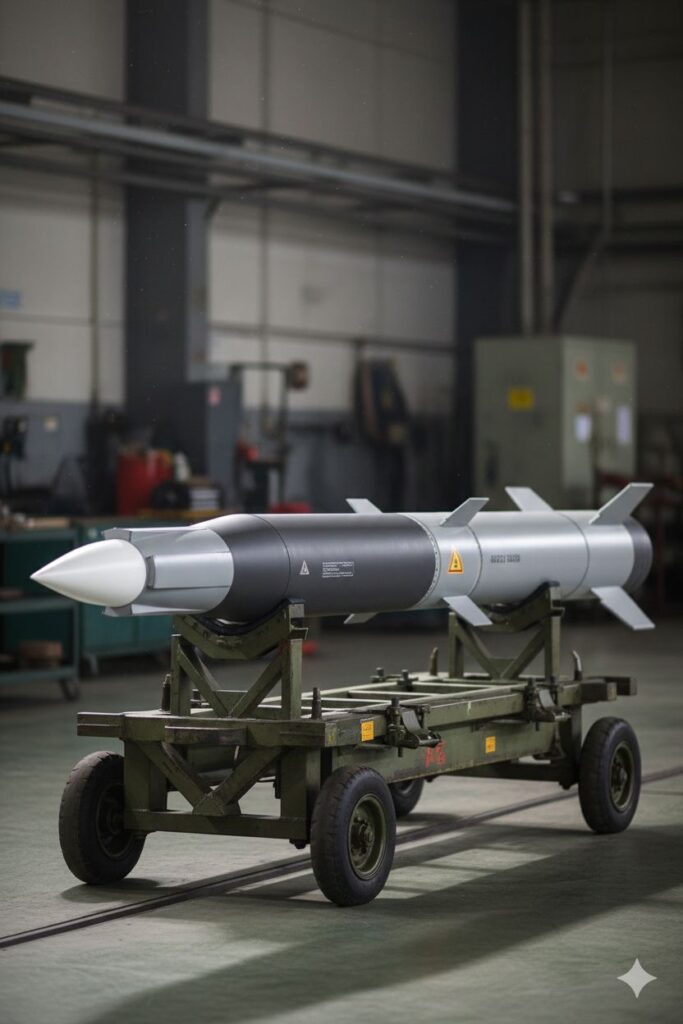
1. The Guidance Section (The “Brain”)
Located right behind the white nose cone (the radome), this contains the seeker head.
• Active Radar: The missile sends out its own radar pulses to find the target.
• Heat Seeking (IR): It looks for the thermal signature of an enemy aircraft’s engine.
2. The Warhead (The “Punch”)
Usually situated in the middle of the airframe. Modern missiles often use proximity fuzes, meaning they don’t have to physically hit the target; they detect when they are closest to the enemy and explode, using a “continuous rod” or “fragmentation” blast to shred the target.
3. The Propulsion System (The “Muscle”)
The rear section consists of a solid-fuel rocket motor.
• Burn Phase: Most missiles have a very short burn time (seconds), accelerating them to supersonic speeds (Mach 3 or higher).
• Gliding Phase: After the fuel is spent, the missile uses its built-in kinetic energy to coast toward the target.
4. Control Surfaces (The “Steering”)
Those fins you see are critical for maneuverability.
• Fixed Fins: Provide stability (like the feathers on an arrow).
• Actuated Fins: Move rapidly to change the missile’s direction, allowing it to pull high-G turns that a human pilot could never survive.
Real-World Counterparts
If you are interested in the real technology this image is mimicking, you might want to look into these specific models:
• AIM-120 AMRAAM: The standard American medium-range radar-guided missile.
• R-77 (AA-12 Adder): A Russian equivalent known for its unique “grid” fins at the back.
• Meteor: A European missile that uses a ramjet engine for much longer powered flight.
Since this image is a digital creation, is there a specific fictional universe or game you’re trying to identify it from, or were you just curious about the engineering?