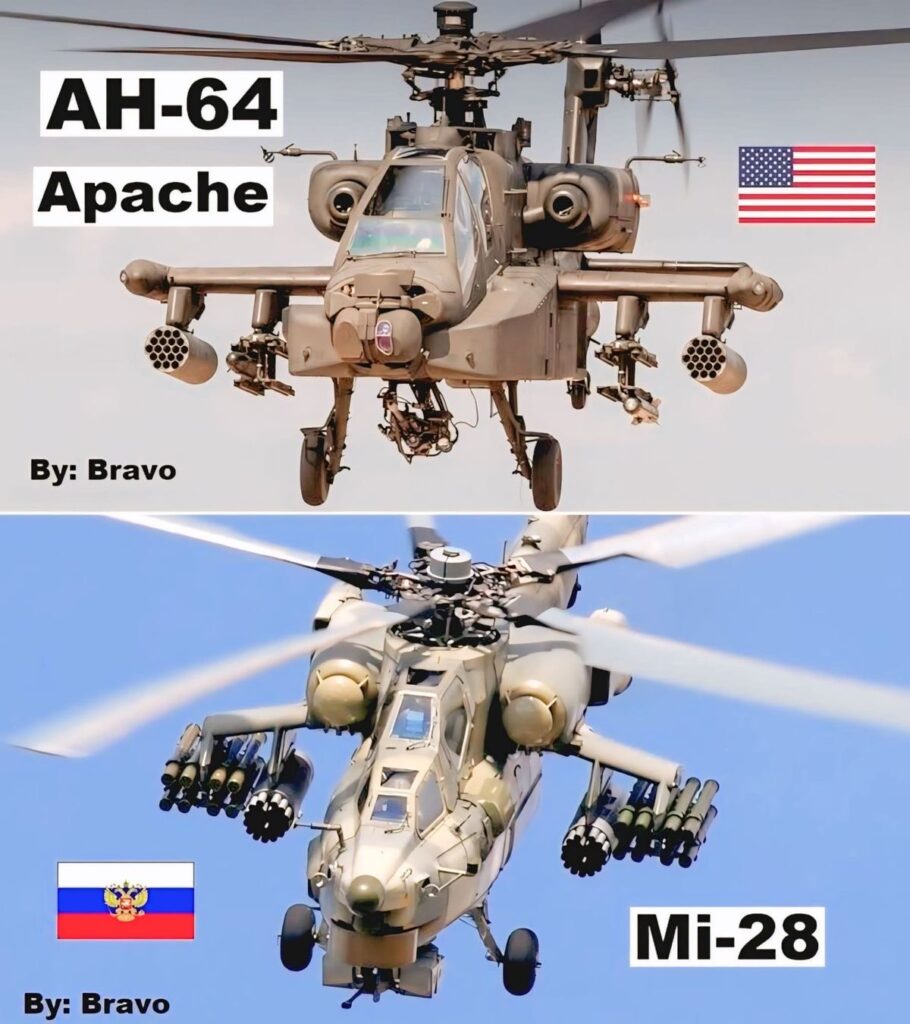
The AH-64 Apache and the Mil Mi-28 Havoc are two of the most advanced attack helicopters in the world, representing the technological philosophies of the United States and Russia. Both aircraft were designed for similar roles—close air support, anti-armor operations, and battlefield dominance—but they differ significantly in design, avionics, and combat approach.
The AH-64 Apache, developed by Boeing, first entered service in the 1980s and has since undergone multiple upgrades, making it one of the most combat-proven helicopters in modern warfare. It is widely known for its advanced targeting systems, including the AN/APG-78 Longbow radar, which allows it to detect, classify, and prioritize targets even in poor weather or at night. This gives the Apache a major advantage in situational awareness and precision strikes. Its primary weapon, the AGM-114 Hellfire missile, is highly accurate and effective against armored vehicles. In addition, it carries a 30mm chain gun and Hydra 70 rocket pods, providing versatility in combat.
On the other hand, the Mi-28 Havoc was developed by Russia as a dedicated attack helicopter to rival Western designs like the Apache. Entering service in the early 2000s, the Mi-28 emphasizes durability, firepower, and survivability. It is heavily armored, with a cockpit designed to withstand significant damage, including small-arms fire and shrapnel. Unlike the Apache, the Mi-28 initially lacked advanced radar systems, although newer variants like the Mi-28NM have improved avionics and night-fighting capabilities. The helicopter is equipped with anti-tank guided missiles such as the Ataka and Khrizantema, along with a powerful 30mm cannon mounted on a flexible turret.
In terms of design philosophy, the Apache prioritizes advanced electronics, network-centric warfare, and precision engagement. It integrates seamlessly with other assets on the battlefield, such as drones and ground forces, making it a key component of modern U.S. military strategy. Its cockpit systems reduce pilot workload and enhance target acquisition, allowing for efficient mission execution.
The Mi-28, in contrast, reflects a more rugged and straightforward approach. It is built to operate in harsh conditions with minimal support, which aligns with Russian military doctrine. Its armor protection is often considered superior to that of the Apache, making it more resilient in high-threat environments. However, earlier models were criticized for limited night operations and less sophisticated targeting systems compared to their Western counterpart.
Performance-wise, both helicopters are similar in speed and maneuverability, with maximum speeds around 300 km/h. However, the Apache generally has an edge in combat effectiveness due to its superior sensors and integration capabilities. The Mi-28 compensates with heavier armor and strong firepower, making it a formidable opponent in direct engagements.
In conclusion, the AH-64 Apache and Mi-28 Havoc represent two different approaches to attack helicopter design. The Apache excels in technology, precision, and battlefield awareness, while the Mi-28 focuses on toughness, firepower, and simplicity. Both are highly capable machines, and their effectiveness ultimately depends on how they are used within their respective military doctrines.