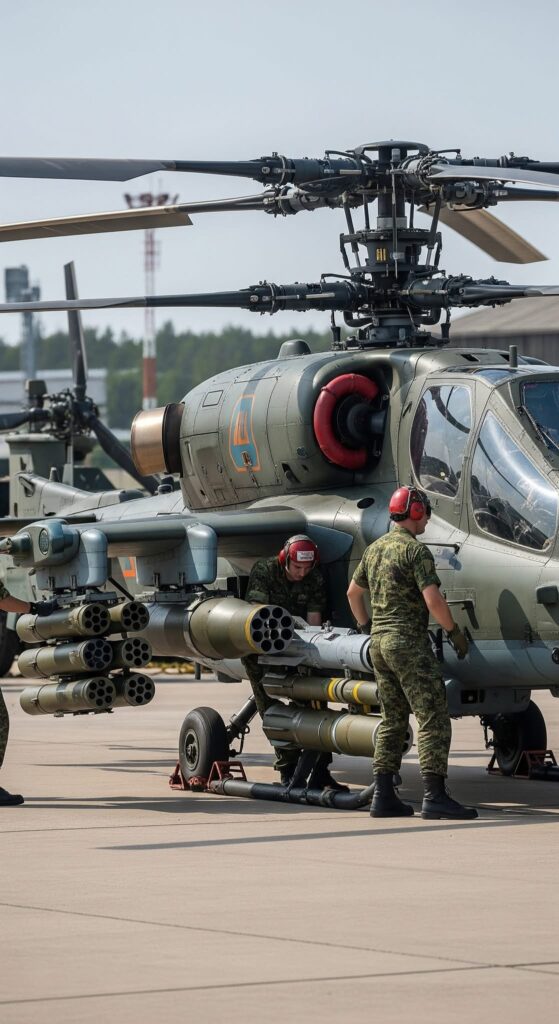
The Kamov Ka-52, known by its NATO reporting name “Alligator,” is a Russian attack helicopter designed to operate in high threat environments and deliver precise firepower while maintaining strong situational awareness. It represents the evolution of the single seat Ka-50 into a more versatile, two seat platform capable of command, control, and strike missions. Since entering service in the mid 2010s, the Ka-52 has become one of the most recognizable helicopters in modern Russian military aviation.
One of the most distinctive features of the Ka-52 is its coaxial rotor system. Instead of a conventional main rotor and tail rotor, it uses two counter rotating rotors mounted on the same axis. This design eliminates the need for a tail rotor, reduces the helicopter’s overall length, and improves maneuverability, especially at low speeds and in confined areas. It also allows the Ka-52 to maintain better stability during aggressive maneuvers, which is critical in combat situations.
The Ka-52 is powered by two Klimov VK-2500 turboshaft engines, giving it strong performance in hot and high conditions. It has a maximum speed of roughly 300 kilometers per hour and a combat radius suited for battlefield support and deep strike missions. The helicopter’s airframe is armored to protect the crew from small arms fire and shell fragments, while key systems are designed with redundancy to improve survivability.
Crew members sit side by side, rather than in a tandem configuration. This layout improves coordination between the pilot and the weapons systems officer, particularly during complex missions such as target designation or command and control of other helicopters. Both crew members have access to modern avionics, including multi function displays, helmet mounted sights, and electro optical targeting systems that allow for day and night operations.
In terms of armament, the Ka-52 is heavily equipped. It carries a 30 mm Shipunov 2A42 cannon mounted on the starboard side, capable of engaging both ground and low flying air targets. External hardpoints allow it to carry a wide range of weapons, including anti tank guided missiles like the Vikhr and Ataka, unguided rockets, and air to air missiles for self defense. This flexibility allows the Ka-52 to adapt to different mission profiles, from close air support to armed reconnaissance.
The helicopter also incorporates advanced sensors and defensive systems. Its radar, mounted above the rotor in some variants, provides target detection and tracking while minimizing exposure. Electronic countermeasures, missile warning systems, and flare dispensers are designed to help the Ka-52 survive in environments with active air defenses.
Operational use of the Ka-52 has highlighted both its strengths and its challenges. It has demonstrated strong firepower and agility, as well as the benefits of its unique rotor design. At the same time, modern conflicts have shown how vulnerable all attack helicopters can be to advanced air defense systems, leading to ongoing adaptations in tactics and equipment.
Overall, the Kamov Ka-52 “Alligator” stands as a bold and unconventional approach to attack helicopter design. Its combination of maneuverability, heavy armament, and advanced avionics makes it a significant platform in contemporary rotary wing warfare and a clear symbol of Kamov’s distinctive engineering philosophy.