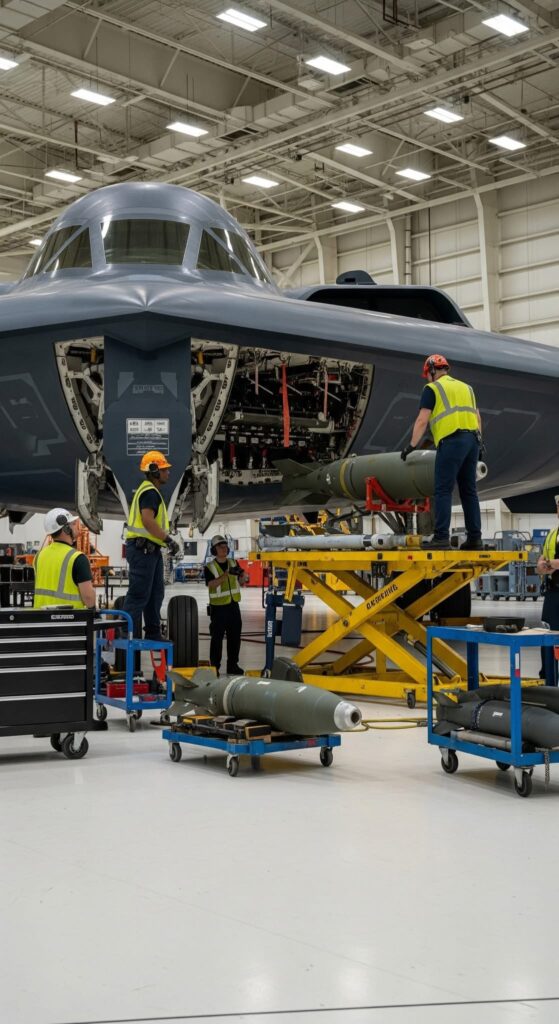
The B-21 Raider represents a major shift in how the United States thinks about airpower, deterrence, and future conflict. It is not just a new bomber replacing an old one. It is a response to a world where threats are more advanced, more distributed, and less predictable than at any point since the Cold War.
At its core, the B-21 is about survivability. Modern air defenses are no longer limited to radar and missiles clustered around a few key locations. They are layered, mobile, and networked across vast areas. Older bombers, even those upgraded over time, struggle to operate safely in that environment. The B-21 is designed from the ground up to penetrate these defenses. Its stealth characteristics are meant to be effective against both current and future detection systems, not just the threats of yesterday. This allows it to reach heavily defended targets that would otherwise be out of reach.
The aircraft is also significant because of its flexibility. Unlike platforms built for a single mission, the B-21 is intended to carry both conventional and nuclear weapons. That dual role matters. It strengthens deterrence by giving decision makers more credible options across the spectrum of conflict. A potential adversary cannot assume that U.S. responses will be slow, predictable, or limited to one domain. The presence of a bomber that can strike precisely, at long range, and with different types of payloads complicates any hostile planning.
Another important aspect is how the B-21 is being developed and sustained. Lessons learned from older programs have shaped its design philosophy. The goal is not just high performance, but affordability and maintainability over decades of service. The B-21 is expected to rely heavily on digital engineering, open systems, and software updates. This means it can evolve as threats change, rather than becoming obsolete or prohibitively expensive to upgrade. In practical terms, it should be easier to keep mission-ready and cheaper to operate than previous stealth bombers.
The B-21 also has strategic value beyond its physical capabilities. It signals long-term commitment. Building a new bomber fleet sends a clear message that the United States intends to maintain a credible global strike capability well into the future. That reassurance matters to allies who depend on U.S. security guarantees. At the same time, it serves as a warning to potential adversaries that attempts to close off regions or deny access will not go unanswered.
Finally, the B-21 reflects how warfare itself is changing. It is expected to operate as part of a broader network, sharing data with other aircraft, satellites, and systems across domains. In this sense, it is not just a bomber, but a node in a larger system of intelligence, surveillance, and strike capabilities. That integration increases effectiveness and reduces reliance on any single platform.
In short, the B-21 is significant because it combines stealth, adaptability, and strategic signaling in one platform. It is designed not only for today’s challenges, but for the uncertain conflicts of the decades ahead.