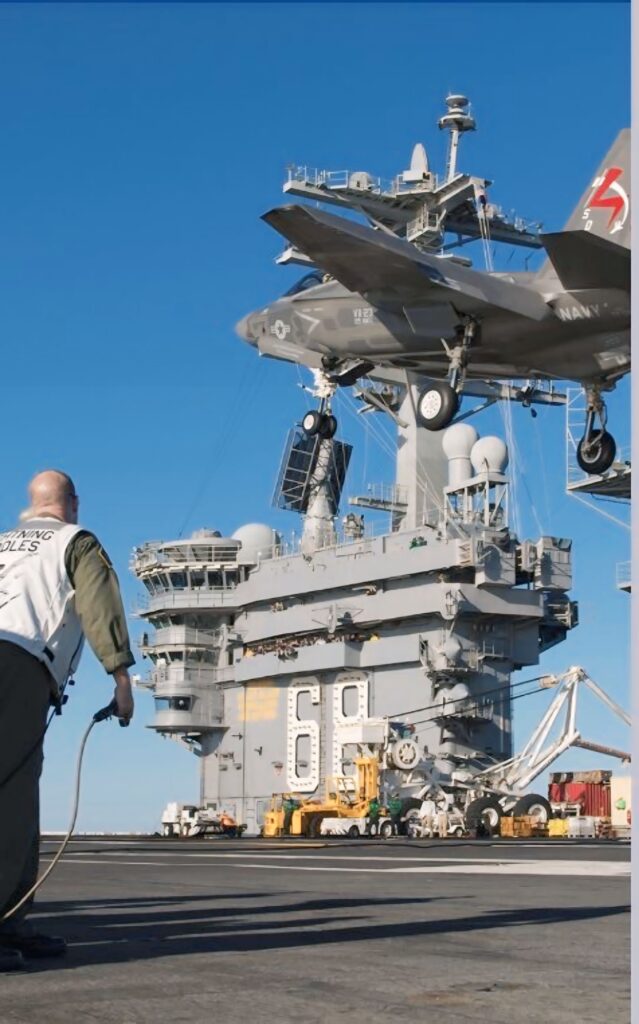
The F-35C Lightning II is the carrier-based variant of the Joint Strike Fighter family and represents a major shift in how naval air power is projected from the sea. Designed specifically for operations from U.S. Navy aircraft carriers, the F-35C combines stealth, advanced sensors, and networked warfare capabilities in a platform built to survive and dominate in modern, high threat environments.
What sets the F-35C apart from its Air Force and Marine Corps counterparts is its adaptation to the harsh demands of carrier aviation. It features the largest wing of the F-35 family, along with folding wingtips that allow it to fit efficiently on crowded carrier decks. The larger wing provides increased lift, better low speed handling, and greater fuel capacity, all critical for safe carrier takeoffs and recoveries. Reinforced landing gear and a stronger airframe allow the aircraft to withstand the impact forces of arrested landings at sea.
Stealth is a defining feature of the F-35C. Its shape, internal weapons bays, and radar absorbing materials are designed to reduce detection by enemy radar systems. This allows the aircraft to penetrate defended airspace and strike high value targets early in a conflict. Unlike older carrier aircraft that rely heavily on escort and support assets, the F-35C can operate deeper and with greater independence while remaining connected to the broader force.
The aircraft’s sensor suite is one of its most powerful strengths. The F-35C uses advanced radar, electro optical systems, and distributed sensors to build a comprehensive picture of the battlespace. This information is fused and presented to the pilot in a clear, usable way, reducing workload and improving decision making. Just as important, the F-35C can share this data with other aircraft, ships, and ground units, acting as a flying sensor node that enhances the effectiveness of the entire strike group.
Powered by the Pratt and Whitney F135 engine, the F-35C delivers strong performance while maintaining efficiency for long range missions. Its internal fuel capacity gives it greater unrefueled range than earlier carrier fighters, extending the reach of the carrier air wing. When needed, it can also carry external fuel tanks and weapons, accepting a reduced stealth profile for missions where payload and range take priority.
Operationally, the F-35C is designed to replace legacy aircraft such as the F/A-18 Hornet in certain roles, while complementing newer Super Hornets. It brings capabilities that previous generations simply did not have, especially in contested environments where information dominance and survivability matter as much as raw firepower.
In summary, the F-35C Lightning II is not just a new fighter for the Navy, but a cornerstone of future carrier operations. By combining stealth, advanced sensors, and seamless connectivity with the durability required for life at sea, it ensures that aircraft carriers remain relevant and lethal in the evolving landscape of modern warfare.