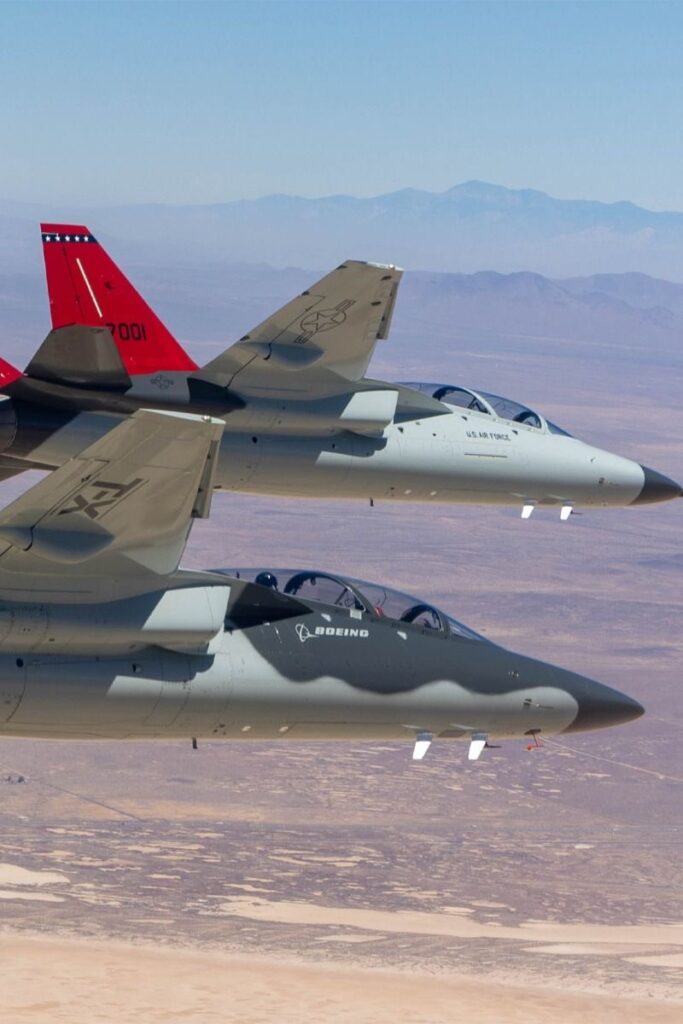
The arrival of the T-7A Red Hawk and the BTX-1 aircraft at Edwards Air Force Base marks an important milestone in the future of U.S. Air Force pilot training. Edwards AFB, long known as the center of American flight testing, provides the ideal environment to evaluate these next-generation trainer aircraft under demanding real-world conditions. Their presence signals a shift toward modernized training methods designed to prepare pilots for the increasingly complex aircraft they will fly in operational service.
The T-7A Red Hawk is the centerpiece of the Air Force’s new Undergraduate Pilot Training program. Developed by Boeing in partnership with Saab, the aircraft was designed from the outset using digital engineering tools. This approach allowed engineers to move from concept to flight testing faster than traditional development programs. At Edwards, the T-7A will undergo extensive testing focused on performance, handling qualities, software integration, and sustainment concepts. These tests are critical to ensuring the aircraft meets the Air Force’s requirements before it enters full operational service.
One of the T-7A’s most important advantages is its ability to replicate the flight characteristics of modern fighter jets through software rather than hardware changes. This flexibility allows instructors to tailor training profiles to better match aircraft like the F-22 and F-35. For student pilots, that means a smoother transition from training aircraft to frontline fighters. For the Air Force, it means a more efficient and adaptable training pipeline.
Alongside the T-7A, the BTX-1 aircraft represents the broader Advanced Pilot Training initiative. While the T-7A is the selected production aircraft, BTX-1 test assets continue to play a role in validating training concepts, ground systems, and maintenance procedures. Their arrival at Edwards allows testers to compare data, refine evaluation methods, and ensure the overall training ecosystem works as intended. This includes simulators, mission planning tools, and ground-based training systems that are just as important as the aircraft themselves.
Edwards Air Force Base offers unique advantages for this work. Its vast airspace, experienced test community, and history with developmental aircraft make it the logical choice for early testing and evaluation. Pilots and engineers can push the aircraft across a wide flight envelope while collecting detailed data on everything from aerodynamics to software behavior. Any issues discovered here can be addressed early, reducing risk and cost later in the program.
The arrival of the T-7A and BTX-1 at Edwards also reflects a broader effort to modernize how the Air Force develops and fields new aircraft. Digital design, open systems architecture, and an emphasis on sustainment from day one are becoming standard practice. These aircraft are not just new trainers; they represent a new way of thinking about acquisition and readiness.
As testing continues at Edwards AFB, the lessons learned from the T-7A and BTX-1 will shape pilot training for decades to come. Their arrival is a clear step toward ensuring future Air Force pilots are better prepared, more adaptable, and ready to meet the demands of modern air combat.