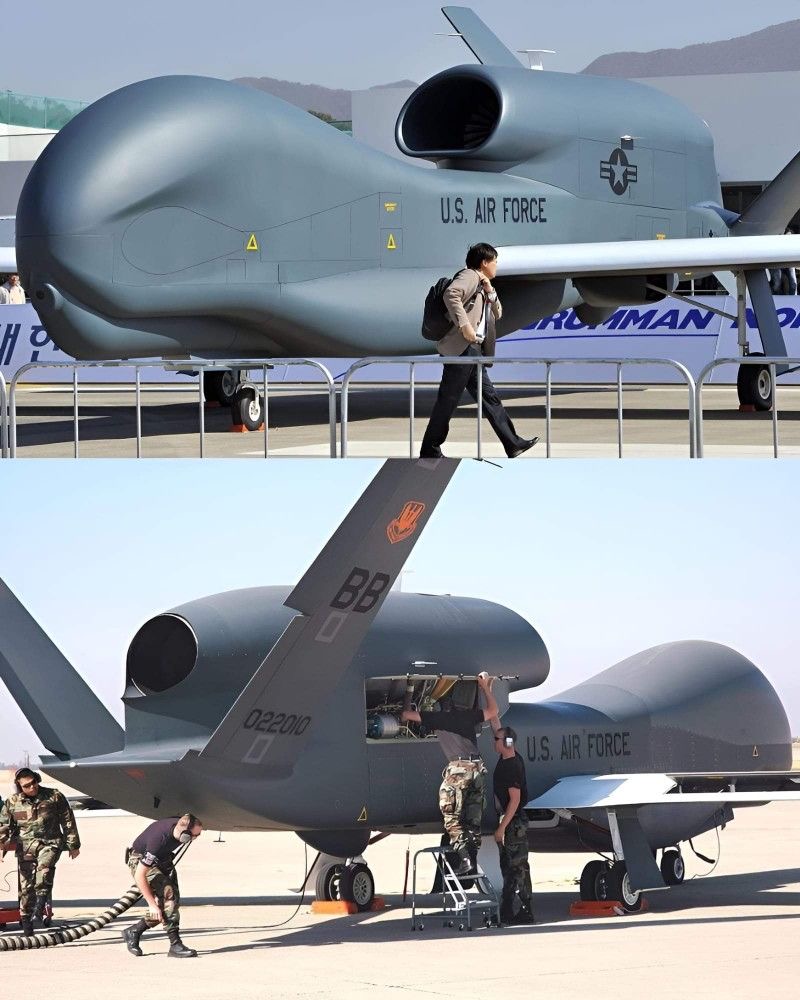
The Grumman RQ-4 Global Hawk is one of the most significant unmanned aircraft ever fielded for military reconnaissance. Designed to fly high, stay airborne for long periods, and gather vast amounts of intelligence, the Global Hawk changed how modern air forces observe the battlefield and the wider world. Rather than replacing manned aircraft, it expanded what was possible by providing persistent surveillance without putting a pilot at risk.
Developed by Northrop Grumman in the 1990s, the Global Hawk was built around a clear mission: long-endurance, high-altitude intelligence, surveillance, and reconnaissance. It can operate at altitudes above 60,000 feet and remain airborne for more than 30 hours. This combination allows it to monitor large areas continuously, something that would be extremely demanding and costly for crewed aircraft. From that altitude, it can scan thousands of square kilometers in a single mission.
What truly defines the RQ-4 is its sensor suite. The aircraft carries advanced radar, electro-optical, and infrared sensors capable of collecting detailed imagery in almost any weather, day or night. Synthetic aperture radar allows it to see through clouds and darkness, while its optical systems provide high-resolution images when conditions are clear. All of this data can be transmitted in near real time to commanders and analysts, enabling faster and better-informed decisions.
The Global Hawk’s design reflects its role. Its long, slender wings give it exceptional lift and efficiency, similar to a glider, which is ideal for high-altitude cruising. The airframe prioritizes endurance and stability rather than speed or maneuverability. It is not meant to evade threats through agility; instead, it relies on altitude, distance, and controlled airspace to operate safely. This makes it especially suited for strategic reconnaissance rather than close-in tactical missions.
Operationally, the RQ-4 has been used in a wide range of scenarios. It has supported military operations by tracking troop movements, monitoring borders, and surveying infrastructure. Beyond combat, it has also been used for humanitarian and disaster-response missions, such as assessing damage after earthquakes or hurricanes. Its ability to quickly map large regions makes it valuable even outside traditional military roles.
Despite its capabilities, the Global Hawk has not been without controversy. It is expensive to build, operate, and maintain, and debates have emerged over whether satellites or newer, smaller drones could fulfill similar roles at lower cost. Some air forces have reduced or restructured their Global Hawk fleets as technology and priorities evolved. Still, its impact on unmanned aviation is undeniable.
In the broader history of aerospace, the Grumman RQ-4 Global Hawk stands as a milestone. It demonstrated that unmanned aircraft could perform strategic missions once reserved for the most advanced manned platforms. More importantly, it reshaped expectations about persistence, reach, and the role of drones in modern warfare and global monitoring.