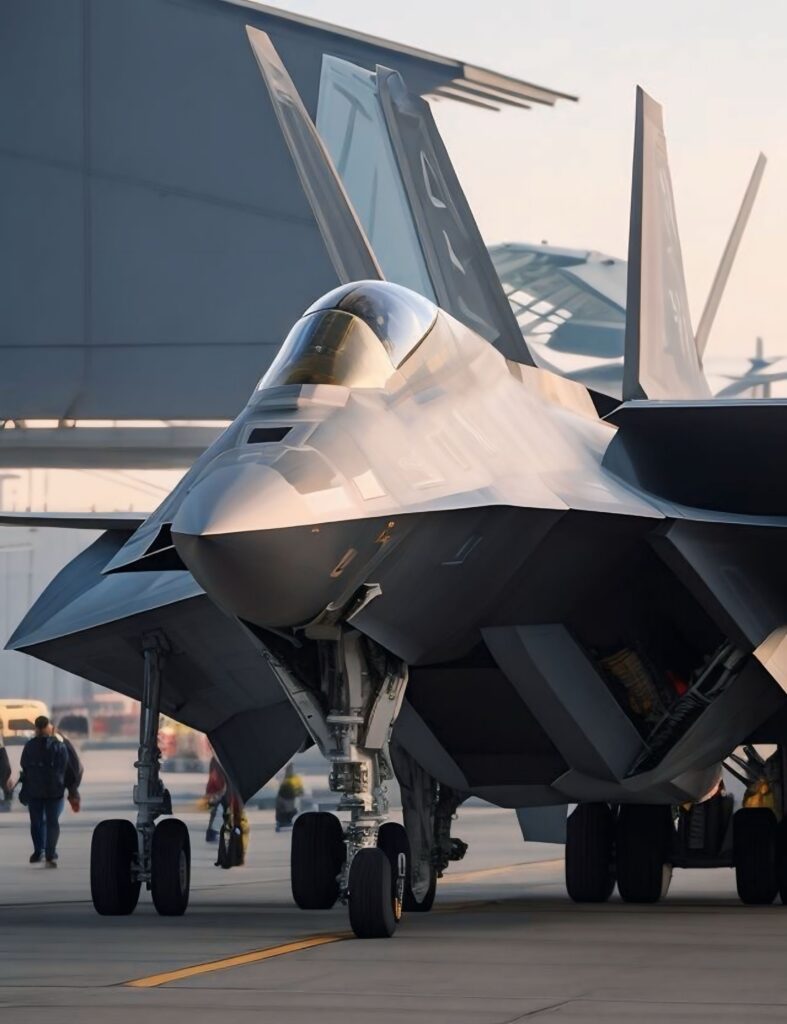
The F-22 Raptor was designed with one clear goal: to dominate the air. From the earliest sketches, engineers focused on creating an aircraft that could see first, strike first, and leave without being detected. Every line, angle, and system on the jet serves that purpose.
The most noticeable feature of the F-22 is its shape. The aircraft uses a blend of sharp edges and smooth curves to reduce its radar signature. Flat surfaces are carefully aligned so radar waves scatter away instead of reflecting back to enemy sensors. Even small details, like the shape of panel edges and access doors, are designed with stealth in mind. Unlike older fighters that carry weapons under their wings, the F-22 stores missiles and bombs inside internal bays. This keeps the aircraft clean and hard to detect while flying at combat speed.
Materials play a major role in the Raptor’s design. The airframe combines advanced aluminum alloys, titanium, and composite materials. Radar-absorbing coatings further reduce visibility, while also being durable enough for regular operations. These materials allow the jet to remain lightweight without sacrificing strength, which is critical for high-speed maneuvering.
One of the defining elements of the F-22 is its engine and exhaust system. The aircraft is powered by two Pratt and Whitney F119 engines, which allow it to fly at supersonic speeds without using afterburners. This ability, known as supercruise, gives the F-22 greater range and faster response times while reducing fuel consumption and infrared signature. The engines are paired with thrust-vectoring nozzles that move during flight. This gives the Raptor exceptional agility, allowing it to outmaneuver opponents even at low speeds or high angles of attack.
The cockpit design reflects a shift toward pilot efficiency rather than raw instrumentation. Instead of being overwhelmed with separate gauges, the pilot sees information fused into a few large displays. Sensors, radar, and electronic warfare systems work together behind the scenes, presenting a clear picture of the battlefield. This allows the pilot to make faster decisions and focus on tactics rather than managing systems.
Aerodynamically, the F-22 is designed for balance. It combines the speed of an interceptor with the agility of a dogfighter. The wide wings and large control surfaces provide stability at high altitude, while still supporting tight turns during close combat. Even the placement of air intakes and tail fins contributes to both stealth and performance.
In the end, the F-22 Raptor’s design is not about any single feature. It is about how stealth, speed, agility, and situational awareness are blended into one aircraft. Each design choice supports the others, creating a fighter that set a new standard for air superiority and remains difficult to challenge even decades after its first flight.